Business class-only airline finally announces first departure after three years
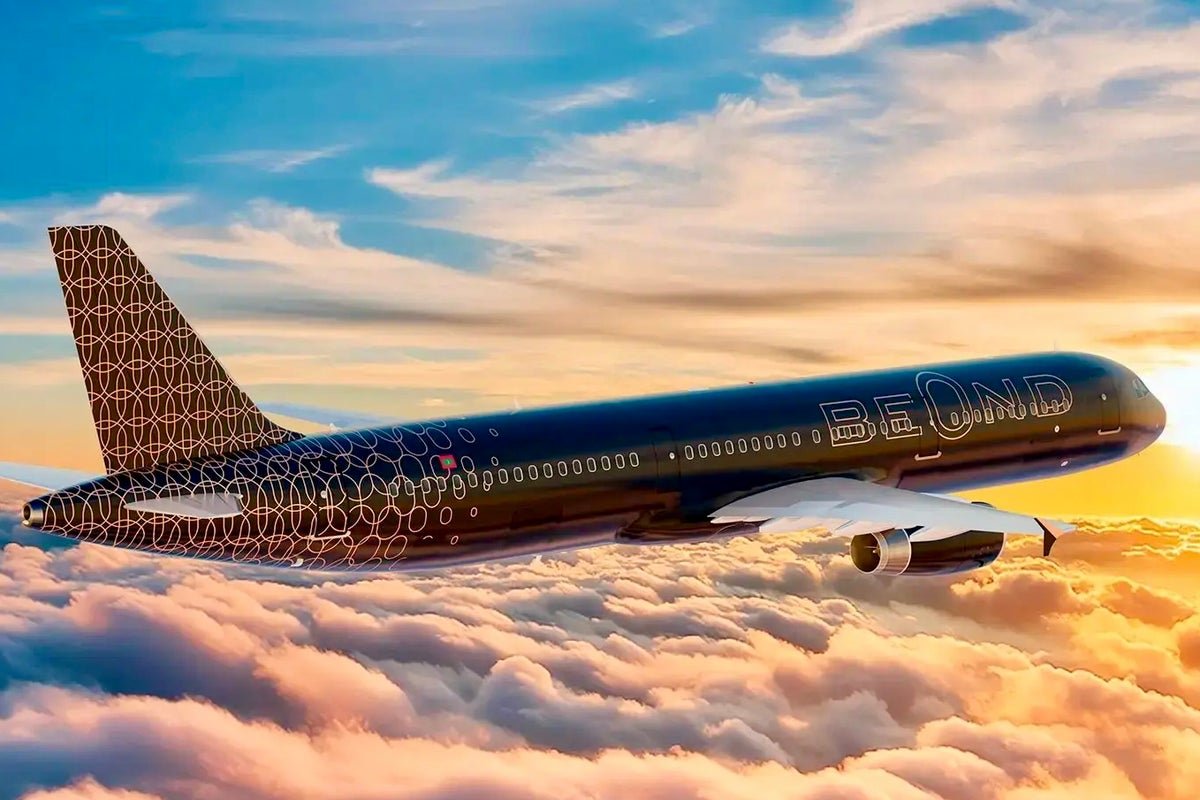
“New ‘premium’ airline promises flights with all lie-flat seats to the Maldives” was the headline of an article The Independent published in 2023. The subject was a start-up carrier called Beond (pronounced “beyond”). It claims to be “the first pure luxury airline.”
Beond aims “to fly you to remote and unspoiled places where you can release the explorer in you and immerse yourself in the experience of a vacation”. That means Male airport in the Maldives, to which flights from London Heathrow begin in December.
A direct business class service is already operating from Milan, Munich and Zurich to the Indian Ocean gateway. But a reminder that “direct” is not the same thing as nonstop. The two aircraft that Beond operates – both ex-UK planes – are unable to cover the 5,000 miles from western Europe to the Maldives in one go. So the planes generally refuel at Dubai’s second airport, World Central (DWC).
The younger plane is a 22-year-old ex-easyJet Airbus 319, which has also seen service with Tui and Sky Airline of Peru. Rather than 156 seats as used by easyJet, it is now equipped with just 44 “fully reclining flat bed” places. The larger aircraft, a 24-year-old ex-British Airways Airbus A321, has 68 such seats.
Just how flat are they, though? Let’s hear from Rhys Jones, aviation editor for the frequent flyer website Head for Points – and no stranger to business class on larger airlines. He was able to make a walk-through of the jet and reports: “Anyone taller than 1.8m is going to struggle to stretch out in bed mode, because there isn’t a ‘proper’ foot well. Instead you get a little corner. I personally would not consider this fully ‘lay flat’ and I wasn’t able to stretch out fully.”
A return trip departing on the first flight from Heathrow to the Maldives, on 16 December, returning a week later, is currently selling at £3,737. This is only one-fifth more expensive than economy on British Airways (Virgin Atlantic is slightly cheaper).
The Club World fare on BA is an astonishing £11,089 – roughly three times as much. Were I looking for a business-class pre-Christmas break in the Maldives (which I am not), I would go one step beyond British Airways to Beond. The bed may not be as flat, and the journey will take around three hours longer, but I would prefer to save over £7,000.
Yet are British travellers prepared to support “the first pure luxury airline”? Let me take you back 18 years to Premjet, which promised “short-haul premium travel” from Luton and Manchester to Malaga, Faro, Palma and Alicante. The airline vowed “to bring back that something special to air travel” by halving the number of seats and doubling the joy. “Sumptuous leather reclining seats, with class-leading legroom… Relax as you enjoy a three-course gourmet meal with complementary [sic] fine wines and champagnes.”
There proved to be no market for luxe from Luton on hops of two or three hours. In the years since 2008, the “legacy” airlines such as British Airways have subtracted rather than added frills to short-haul business class. At the same time, long-haul travel in the posh seats has become ever more indulgent. So surely there is a place for Beond?
Perhaps. But the survival rate for all-business class services is depressingly low. Twenty years ago Eos and MAXjet (from Stansted) and Silverjet (from Luton) lined up to compete on London-New York. They refitted safe but elderly Boeing jets to fly the Atlantic, at fares well below the likes of British Airways and Virgin Atlantic. Yet the trio failed in quick succession in 2008. They lacked three essentials for enticing business and premium leisure passengers: feeder networks, frequency and loyalty programmes.
The Maldives is a very different market from Manhattan. Could this be the long-haul premium jet that finally corners the British market? Unfortunately, history suggests that well-heeled passengers do not like refuelling stops. The British Airways “son-of-Concorde” Airbus A318 operation from London City to New York JFK had to refuel outbound at Shannon in Ireland. Travellers were glad to go through US Customs and Border Protection during the stop, but the service did not convince the corporate market.
If you are going to be stopping in Dubai, the prospect of a stroll around and some light shopping may appeal more than sitting on the ground watching the refuellers in action. That spells Emirates, which will offer competitive fares for people prepared to change planes. So while I wish Beond well, I do not tip it for long-term success. But I hope I turn out to be wrong.
Read more: UK travel firm spends £1m to rescue stranded holidaymakers from Asia