
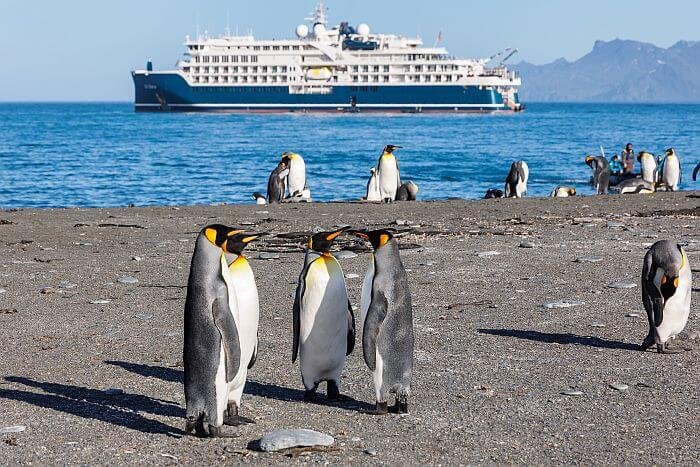
Antarctica Cruises and Ship Sizes: Find Your Sweet Spot

A trip to Antarctica is a major bucket list adventure that is not planned or experienced lightly. Some people want to tick off a seventh continent, some look at it as a major frontier to explore, and others want to visit a destination where animals have the run of the place. Antarctica cruises are a hefty investment though, in both time and money, so it’s important to plan carefully and pick the best kind of ship for your memorable time at sea.

For most travelers who are reading Luxury Latin America, the best Antarctica cruise ship options are expedition vessels carrying roughly 100 to 200 guests. That range gets you ashore twice a day on a typical Antarctic Peninsula voyage while still offering nicely outfitted cabins, memorable meals, and a capable expedition team. If service and comfort rank high for you, a luxury ship in that same band will often have a guest-to-staff ratio of 2-to-1 or less.
Size shapes nearly everything on Antarctica cruises: how long you stand among penguins, how often you board a Zodiac, how steady the Drake Passage feels, and what you pay per day. Fares run from about $6,000 for a short fly-cruise in shoulder season to as much as a new car for longer luxury voyages. Choosing the right vessel can lead to lots of smiles and lasting memories. Choosing the wrong vessel can leave you watching the continent from a railing.
If you sail with a well-established company we’ve covered on our site, such as Swan Hellenic, you can book being sure that they have been running Antarctic Cruises for years and have served thousands of well-traveled passengers who rate them highly.
How Does Ship Size Affect Landing Access and Your Antarctica Experience?
Passenger count sets your time ashore, because Antarctic tourism runs on hard limits. Under the Antarctic Treaty framework, the International Association of Antarctica Tour Operators (IAATO) allows no more than 100 people ashore from one ship at a single site, with roughly one guide per 20 guests. Ships with 300+ passengers will need 4 landings. Those carrying more than 500 passengers will not land anyone.
On a vessel with 100 or fewer guests, everyone can go ashore together for the full visit. Above that, you’re split into groups that alternate between Zodiac landings and Zodiac excursions or kayaking among the ice. This can impact how much time you have ashore in the right light and weather window.

Each ship receives a fixed window at a site, about five to six hours. Larger Antarctica expedition ships spend more of that window loading boats, and expedition guides estimate the loss at around 30 minutes per landing. On a big ship, the last group called may wait an hour while earlier groups watch whales you’ll miss.
Size also shapes Antarctica cruise itineraries. Smaller Antarctica cruise ships slip into narrow channels and capacity-limited sites, while bigger vessels stick to larger landing areas. The main trade-off is motion: smaller hulls roll more on the Drake unless they employ the kind of constantly adjusting stabilizers than an expensive yacht-style vessel from Scenic can afford.
Small Ships: Intimate Expeditions and High-Service Luxury
Small ship Antarctica cruises, from sub-100 vessels up to about 200 guests, deliver the most time on land and, at the top end, the most polished service on the continent. Expect to pay more per person, since fixed costs are spread across fewer guests.
Some of these are expedition-focused small ships. These lines put their effort into guides, activities, and landings. There may be an expert author or wildlife photographer aboard and you’ll find an unusually broad menu of camping, kayaking, snowshoeing, and even scuba diving. A couple of companies carry helicopters to reach more inaccessible areas.
We highlighted one small ship company that runs fly-cruises from Punta Arenas, Chile, skipping the Drake entirely with a flight to the South Shetlands. See the full story here on flying to Antarctica.
Luxury and High-Service Small Ships
Luxury Antarctica cruises keep the small-ship landing advantage and add suites, butler service, and refined dining. Swan Hellenic, a heritage line with purpose-built polar-class ships, sails vessels carrying roughly 150 to 200 guests and pairs its comfortable interiors with a strong lecture program. It suits you if you want a thoughtful, enrichment-led voyage. One of our writers traveled with them in Antarctica and then kept going to South Africa.

National Geographic–Lindblad Expeditions operates the 138-guest National Geographic Endurance, a ship with a long-standing reputation for naturalists and photography instructors. Silversea Expeditions’ Silver Endeavour leans into butler-served suites and fine dining.
Ponant’s Le Commandant Charcot, a 200-guest icebreaker, reaches places such as the Bellingshausen Sea that conventional hulls cannot, while their La Boreal is larger, with more facilities. See our Ponant Antarctica cruise experience story in the online magazine.
Scenic’s luxury ships sit at a more modest size but deliver all-inclusive service (even on some of the world’s best whiskies, fine cuisine, and good wine) plus extras such as helicopters and submersibles on select sailings for a fee.
Most expedition fares include meals, parkas, boots, and shore activities; luxury lines often add drinks, gratuities, and sometimes flights. Compare inclusions line by line before treating a higher fare as the costlier option.
Larger Expedition Ships: More Amenities, More Landing Rotations
Larger expedition ships in the 210 to 500 range still land you in Antarctica, but you’ll share each site with your fellow guests in shifts. In exchange, you get steadier crossings, more public space, and often lower fares.
Most Antarctic Peninsula cruises leave Ushuaia, Argentina, cross the Drake Passage in about two days each way, and spend six or seven days around the peninsula and the South Shetland Islands. On a larger ship, expect a rotation where one group lands while another takes Zodiac cruises, then the two swap. Some of the largest landing-capable ships manage one landing per day.

Itinerary matters too. Longer routes through the Falkland Islands and South Georgia reward small ships, because South Georgia’s wildlife concentrates on beaches such as Salisbury Plain, where you’ll want every available minute. If crossing the Antarctic Circle is your goal, look for a ship with a high ice class.
A larger ship makes sense if you’re prone to seasickness, prefer onboard variety, or are watching your budget. Aim for the smaller end of the range to limit time spent waiting your turn.
Why Avoid Antarctica Cruises That Never Land?
Skip any Antarctica “scenic cruise” (not to be confused with the brand with a capital “S”) on a ship carrying more than 500 passengers, because IAATO rules bar it from landing a single guest. Mainstream lines such as Princess, Celebrity, Holland America, and Norwegian sail past the continent with thousands aboard, and you’ll see glaciers and penguins only through binoculars.
These voyages also spend little time in Antarctica. A typical 16-day sailing between Santiago and Buenos Aires devotes about four days to Antarctic waters, with three to four days on the Drake and the rest at South American ports and the Falklands. Base fares look low, sometimes a fraction of an expedition fare, but Wi-Fi, drinks, specialty dining, and cold-weather gear are often extra.
It’s a sub-par experience all around. What you give up is the core of an Antarctic Peninsula cruise: standing on a beach as gentoos wander past, hearing a rookery, cruising beside a humpback in a Zodiac. None of that happens from an upper deck.
If cost is pushing you toward a scenic-only sailing, look first at a shoulder-season departure in November or March on a 100- to 200-guest expedition ship, or a fly-cruise from Punta Arenas. Those remain among the best Antarctica cruises for value because every fare includes setting foot on the continent.