

China: Ultimate Travel Guide for Canadians

With China having relaxed its visa requirements for Canadians, there’s never been a better time to visit. Whether you’re hoping to explore historic landmarks like the Great Wall of China and the Forbidden City or experience the futuristic skylines of Shanghai and Shenzhen, the country offers an incredible variety of destinations and experiences. One of China’s greatest strengths is its world-class infrastructure, with an extensive network of high-speed rail, modern airports, and efficient public transit making it easy to travel throughout the country.
However, traveling in China does come with a few challenges. The language barrier can be difficult to overcome in many situations, particularly outside major tourist areas, and many everyday tasks rely on Chinese apps that can take some time to learn. While this may feel intimidating at first, it’s also one of the most rewarding aspects of visiting China, offering the opportunity to immerse yourself in a different culture and experience daily life in a way that few destinations can match.
Best Time to Visit China
China is without a doubt a four-season destination; however, the best time to visit China is generally spring and fall, when weather conditions are comfortable across most regions.
Best overall windows
- April to May: Mild temperatures and clear skies.
- September to October: The most reliable “sweet spot” with crisp air, low humidity, and excellent visibility.
Other seasons
- June to August: Hot and humid in many cities. Can experience heavy and prolonged rainfall.
- December to February: Cold in the north, but fewer crowds and a good option if you want winter scenery.
Avoid
- Chinese New Year (Jan–Feb, dates vary)
- National Day of the People’s Republic of China (early October)
Aside from considering the weather, it’s also worth avoiding peak travel periods if possible to avoid overcrowding at tourist hotspots. With a population of more than 1.4 billion people, public spaces in China are just in general very crowded. This is especially the case at iconic attractions such as along the Shanghai Bund and the Great Wall of China.
Many of the country’s most popular tourist attractions require advance reservations to help manage visitor numbers. Admission fees are often inexpensive, with timed-entry tickets designed primarily to control overcrowding rather than generate revenue. If your schedule allows, consider visiting during the shoulder seasons. You’ll have a better chance of securing your preferred entry time and may encounter slightly smaller crowds.
That said, after several trips to China, I can confidently say that large crowds are simply part of the experience. Whether you’re visiting famous landmarks, riding public transit, or exploring city streets, you should expect to encounter significant numbers of people almost everywhere you go.
How to Get to China (with Points)
For most travelers, the best value usually comes from connecting through Japan, Taiwan, Hong Kong, or South Korea rather than trying to find nonstop award space from North America. Airlines such as ANA, Japan Airlines, EVA Air, Cathay Pacific, and China Airlines often provide a significantly better onboard experience than flying nonstop along with having much greater award availability compared to the mainland Chinese carriers.
If you’re looking for business class, Aeroplan is typically the easiest program to use due to its large partner network and transfer partnerships with major Canadian and U.S. credit card programs.
For those seeking aspirational redemptions, ANA business class, Japan Airlines business class, EVA Air business class, and Cathay Pacific business class are all excellent ways to get to China using points.
- Air Canada Aeroplan is one of the most useful programs for transpacific flights. You can redeem points on partners such as Air China, ANA, EVA Air, and Singapore Airlines to reach cities throughout China. Air Canada also operates an extensive transpacific network. If you can find award availability at the lower end of its dynamic pricing range, it can represent a solid redemption option for travel to China.
- Alaska Airlines Atmos Rewards can provide excellent value on carriers such as Japan Airlines, Korean Air, and Starlux Airlines often with lower mileage costs than competing programs.
- American Airlines AAdvantage miles are also highly valuable thanks to their relatively low fees and strong partner award pricing, particularly on airlines like Japan Airlines and Alaska Airlines.
- United MileagePlus offers extensive access across the Pacific thanks to United’s large transpacific route network. Pairing a United co-branded credit card with MileagePlus elite status can provide access to additional award inventory and improve your chances of finding available flights.
- Air France KLM Flying Blue is a useful program for access to Taipei-based China Airlines award space. China Airlines often offers solid award availability in business class, and frequent Flying Blue transfer bonuses can further improve already competitive redemption rates.
- Singapore KrisFlyer can be a strong option if you have U.S.-based transferable credit card points and are willing to connect through Singapore.
China Visa Requirements for Canadians
As of February 17, 2026, Canadian citizens holding an ordinary passport can enter China visa-free for up to 30 days for tourism, business, visiting family and friends, exchanges, and transit. The policy is currently scheduled to remain in effect until December 31, 2026.
This is a temporary policy and is scheduled to expire at the end of 2026, unless extended.
Canadians who enter visa-free must still complete an Entry Declaration Filing prior to arrival. This can be done on the official Chinese National Immigration Administration website.
You will need to submit a photo of your passport along with all of your travel details, including the amount of time you plan to stay in the country, your arriving and departing flights, along with what cities you plan on visiting as well as the address of your accommodations.
Once completed you will receive a QR code that you will need to show an immigration officer at passport control. Do this before you board your flight to China so you won’t have to do this while standing in the immigration line.
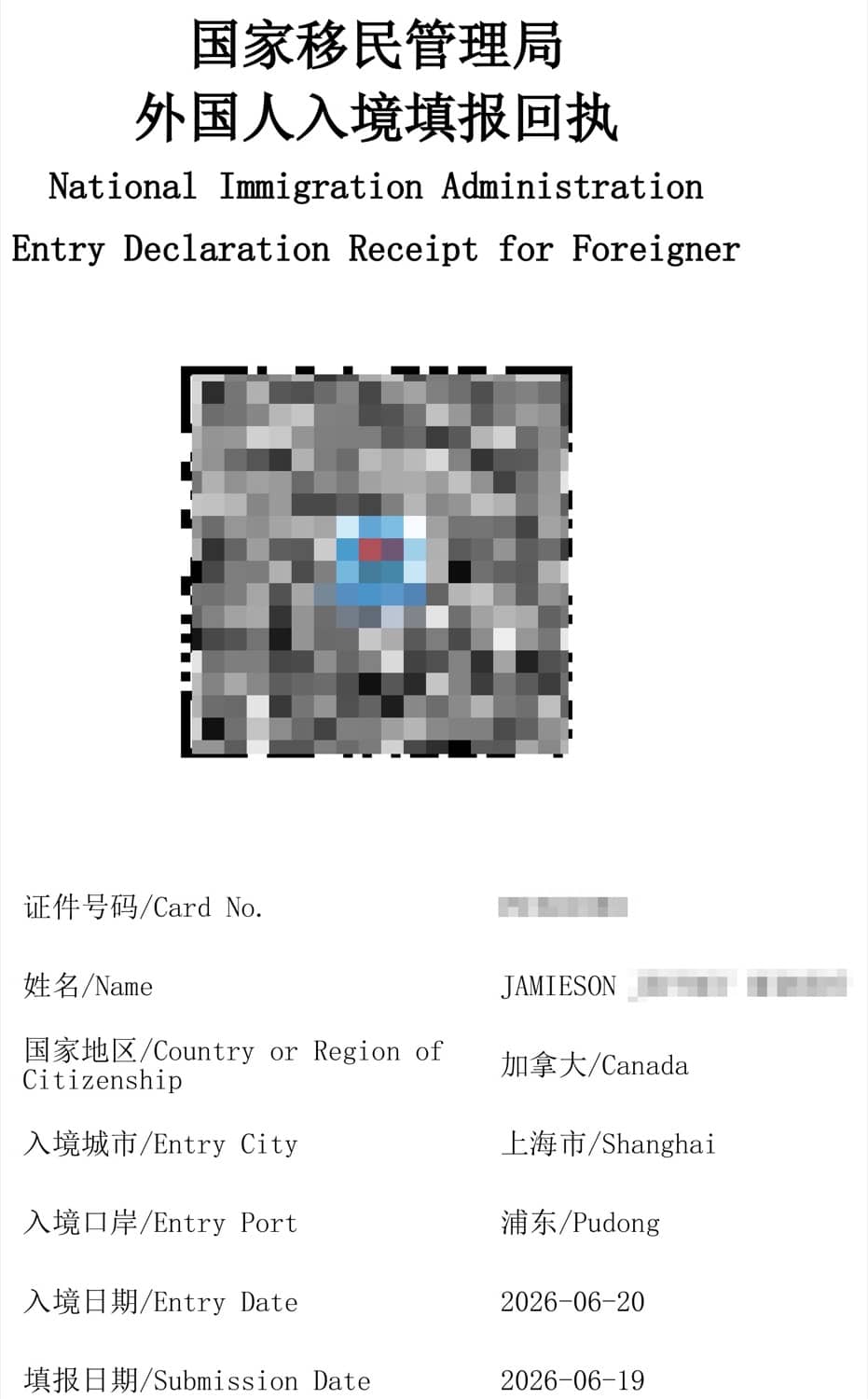
Once you’ve completed your arrival declaration, the entry process is similar to that of many other countries. Before being admitted to China, you’ll be required to provide your fingerprints and have your photo taken at immigration.
Essential Apps & Tech Before You Go
eSim with a Lot of Data
China is a very technologically advanced and largely cashless society, particularly in its major cities, so you’ll be relying heavily on your smartphone for everything from payments and transit to translation, ordering food, and navigation.
That said, you’ll need to familiarize yourself with Chinese apps, as many popular North American services are unavailable in China. This includes platforms such as Facebook, Instagram, WhatsApp, and most Google services, all of which are blocked.
There are a couple of workarounds for this. One option is using a foreign (non-Chinese) eSIM on your phone, since providers based outside of China, such as Airalo, Saily or Google Fi, can route your data through international networks and help avoid local internet restrictions.
The other option is to use a VPN. A VPN, or virtual private network, encrypts your internet connection and routes it through a server in another country, which makes it appear as though you are browsing from outside of China.
However, I don’t really recommend this approach. When I tried several VPNs in China, they were unreliable and often only worked intermittently before dropping out. Chinese authorities are aware of VPN usage and actively filter and block VPN traffic, which makes trying to use VPNs not worth the hassle as far as I’m concerned.
For that reason, it usually isn’t worth the hassle compared to simpler options like using a non-Chinese eSIM, which tends to be far more stable and straightforward.
The reason I suggest getting an eSIM plan with plenty of data is that hotel Wi-Fi in China is close to useless for foreigners as you won’t be able to access many North America-based apps due to network restrictions. As a result, you’ll likely never connect to your hotel Wi-Fi while you’re in the country.
As I mentioned, you’ll be using your phone and data a lot, so it’s worth choosing a larger data package, or even an unlimited plan if you’re staying for a longer period, to avoid running out while you’re on the move.
Alipay
If there’s one app that is an absolute non-negotiable, must-have while in China, it’s Alipay. At first, I was a little skeptical about having to rely on one app so much, but the more comfortable I got using it I was fully converted. It’s a remarkably well-designed platform that handles nearly everything you’ll need in one place.
Although much of Alipay’s interface is in Chinese, the app includes a built-in translator that works well and provides enough English to make it easy for most visitors to use.
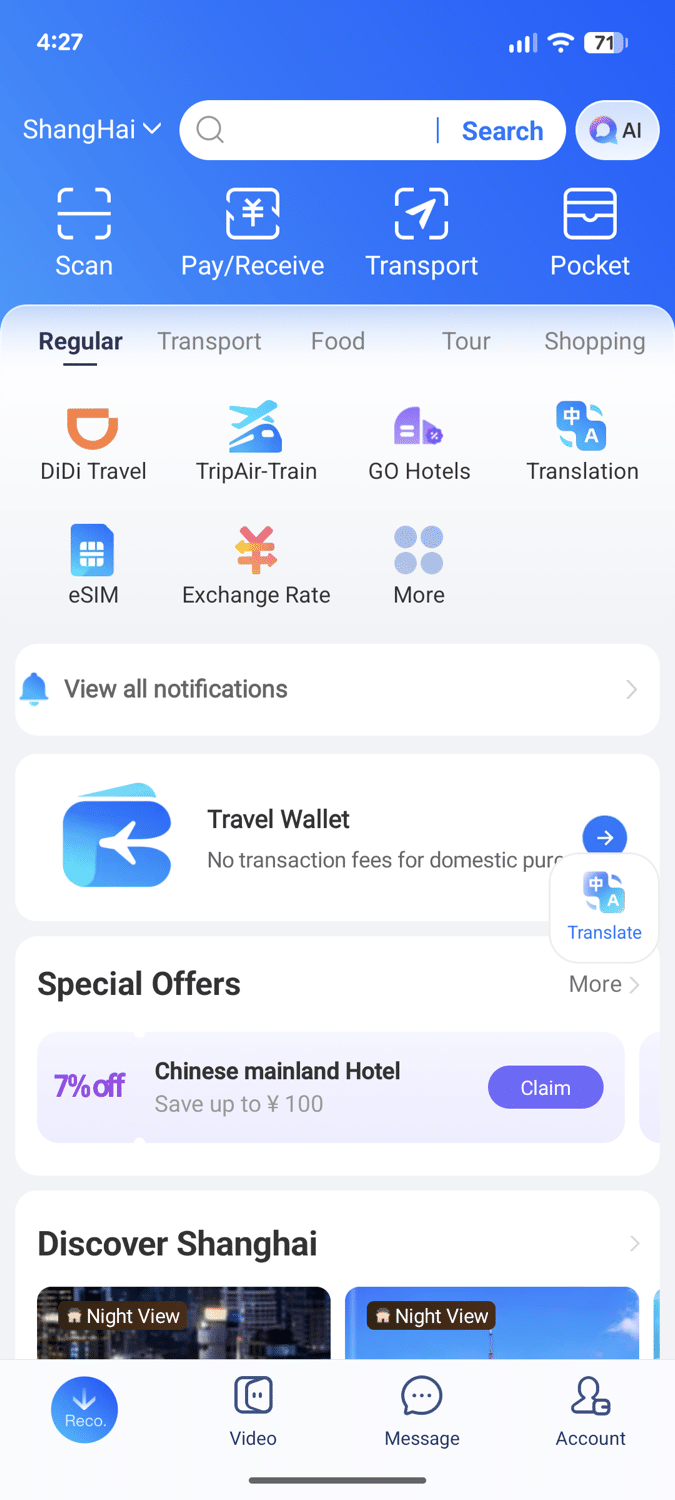
The most common task you will be using Alipay for is making cashless payments. Cash isn’t really a thing for everyday purchases in China, and Alipay is universally accepted across China.
That, however, only just scratches the surface of what Alipay can do though.
You can also use Alipay to:
- Place food orders at restaurants
- Order a DiDi (Chinese equivalent to Uber/Lyft)
- Book domestic flight and train tickets
- Pay for the metro in most major cities
- Book tour tickets
- And more!
I strongly recommend setting up Alipay before your trip so everything is ready to go as soon as you land in China, rather than trying to sort it out at the airport.
Setup requires verifying your phone number via text message and linking a credit card to the app. All major North American credit cards are accepted. I used a U.S.-issued American Express card with Alipay without any issues.
If you need to make large purchases (over $500) you will need to verify your ID by uploading a photo of your passport and complete a facial scan. Completing the ID check also unlocks the full functionality of Alipay, so I recommend doing it as it only takes a few minutes.
Navigation Apps
For those using Apple devices, Apple Maps works well in China and functions as expected. Android users can still use Google Maps, but I found it to be unreliable and of limited use during my trip.
Instead, I highly recommend using AMAP. The app offers an English-language interface and I found it to be far more accurate than Google Maps. It worked well everywhere we traveled, including for navigating public transit, and was particularly useful for finding our way through large underground metro stations.
Translation Apps
English is not widely spoken in China, so a translation app is often helpful when communicating with a DiDi driver, ordering food at restaurants, or speaking with hotel staff.
Both Chinese and English are used throughout the transportation network, including at airports, train stations, and on metro systems, making it relatively easy for international visitors to navigate.
Even at Western-branded hotels such as Marriott and Hilton, the level of English can vary quite a bit. Some staff members speak English very well, while others have more limited proficiency, and this can differ from property to property. Front desk teams usually have the strongest English skills, while communication elsewhere in the hotel may be more limited.
Google Translate worked well for us. With either a reliable data connection through an eSIM or the offline Chinese language pack downloaded in advance, it should be more than enough to help you get by in China.
Power Banks
Since we rely so heavily on our phones while traveling, especially in China, keeping them charged is essential. Many travelers carry one or more power banks to ensure they stay connected throughout their trip.
If you’re flying domestically within China, security officers will ask whether you have a power bank in your carry-on baggage. They may inspect the device, and if it does not meet the required safety standards or doesn’t have a valid China Compulsory Certification (CCC) marking, you will not be permitted to bring it onboard. This will likely result in the power bank being surrendered at the airport with no recourse for recovery.

My understanding is that this requirement applies only to domestic flights and not to international flights or domestic train travel. However, I was asked to present my power banks for inspection on international flights as well. To avoid any issues, it’s a good idea to ensure that your power bank displays the CCC certification mark shown above.
Getting Around China
Air Travel
Many major cities in China have two airports, with one typically handling international flights and the other serving domestic and shorter regional routes. These airports are often located well outside the city center and main tourist areas.
Fortunately, cities like Shanghai and Beijing have excellent public transit systems with convenient connections to the major airports, helping reduce the hassle of longer transfers. In addition, DiDi ride-hailing is widely available and generally very affordable, making airport transfers straightforward and flexible.
When requesting a ride through DiDi at an airport, you may notice a large display board showing what appears to be a lot of random information. However, it’s important to pay attention to this screen, as it will display your assigned vehicle’s license plate number and indicate the specific parking stall where your driver is waiting.

This process isn’t particularly intuitive, and there was little guidance provided at the airport. We ultimately had to figure it out ourselves, so it’s something to be aware of before arriving.
Aside from getting to and from the airport, processes in China are much like major international airports anywhere else in the world. You may notice a higher level of security screening than in some countries, but enhanced security measures are common throughout China and generally won’t have a significant impact on your travel experience.
High-Speed Rail
China’s high-speed rail network is one of the most modern and extensive in the world, linking nearly every major city across the country. For many journeys, the high-speed rail is often the fastest, most convenient, and comfortable way to travel.
China’s major cities have large, modern railway stations. These stations are spacious, clean, and highly organized, with clear signage that includes English. Before entering the platform area, you must pass through a security screening similar to airport checks.

For foreign visitors, purchasing a rail ticket through Trip.com will be the easiest as it is much more user-friendly than a Chinese-based website or app.
Within Alipay you can access the Trip.com mini-app by selecting the TripAir-Train option from the homepage, where you can purchase rail tickets.
Train tickets open up for purchase exactly two weeks prior to the departure date and can sell quickly, especially if you are traveling during a busy season.
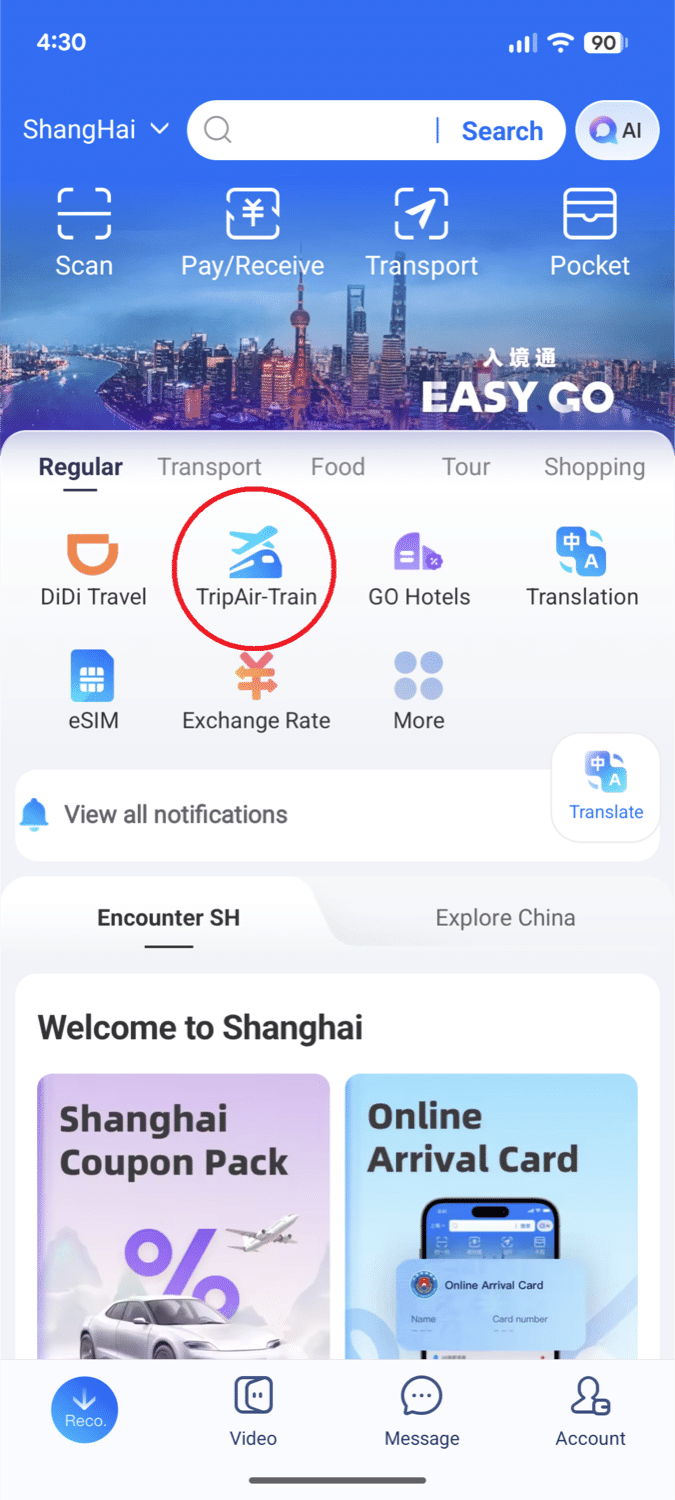
From there, you can proceed through the booking process as normal, but take extra care when entering your passport details, as there are no physical or digital rail tickets in China. Your passport is your ticket!
You’ll typically find three classes of service available on high-speed trains:
- Second Class: The most common and affordable option, arranged in a 2–3 configuration.
- First Class: Provides extra space, with wider seats and more legroom in a 2–2 layout.
- Business Class: The premium cabin, featuring fully reclining seats, arranged in a 1–1 layout for maximum privacy
Below is an example of the Second Class seating, which I found to be perfectly adequate for the 4.5-hour journey from Shanghai to Beijing. The seats offer decent legroom and come equipped with a tray table and USB charging outlet at every seat. Because of this, I don’t think it’s necessary to pay for a higher class of service unless you’re traveling on a much longer route or simply prefer the added space and privacy.
You can expect to pay around $100 for a one-way high-speed rail trip in Second Class from Shanghai to Beijing.

You can also use Trip.com to book hotels, flights, tickets for attractions and tours, and more.
At major railway stations, you may see automated gates that allow passengers to scan their ID and enter the waiting areas and train platforms; however, these automated gates only work for those with a Chinese ID.
If you have a foreign passport, you’ll need to find a lane marked as “Manual Channel”, where your ID will be physically verified by an agent.

City and Urban Metro
China’s metro systems are modern, well organized, and easy to navigate. If you’ve used public transit in cities such as Tokyo, Hong Kong, or Taipei, you’ll have no trouble navigating the metro in China. Stations are clean, safe, and clearly marked in both Chinese and English. In cities like Shanghai, stations and lines are numbered and are assigned a unique color, making it easy to follow your route without having to memorize station names.

Paying for the metro is straightforward. In Shanghai, you can simply tap a credit card on a contactless reader at the fare gates when entering and exiting the system, with no additional setup or tickets required.

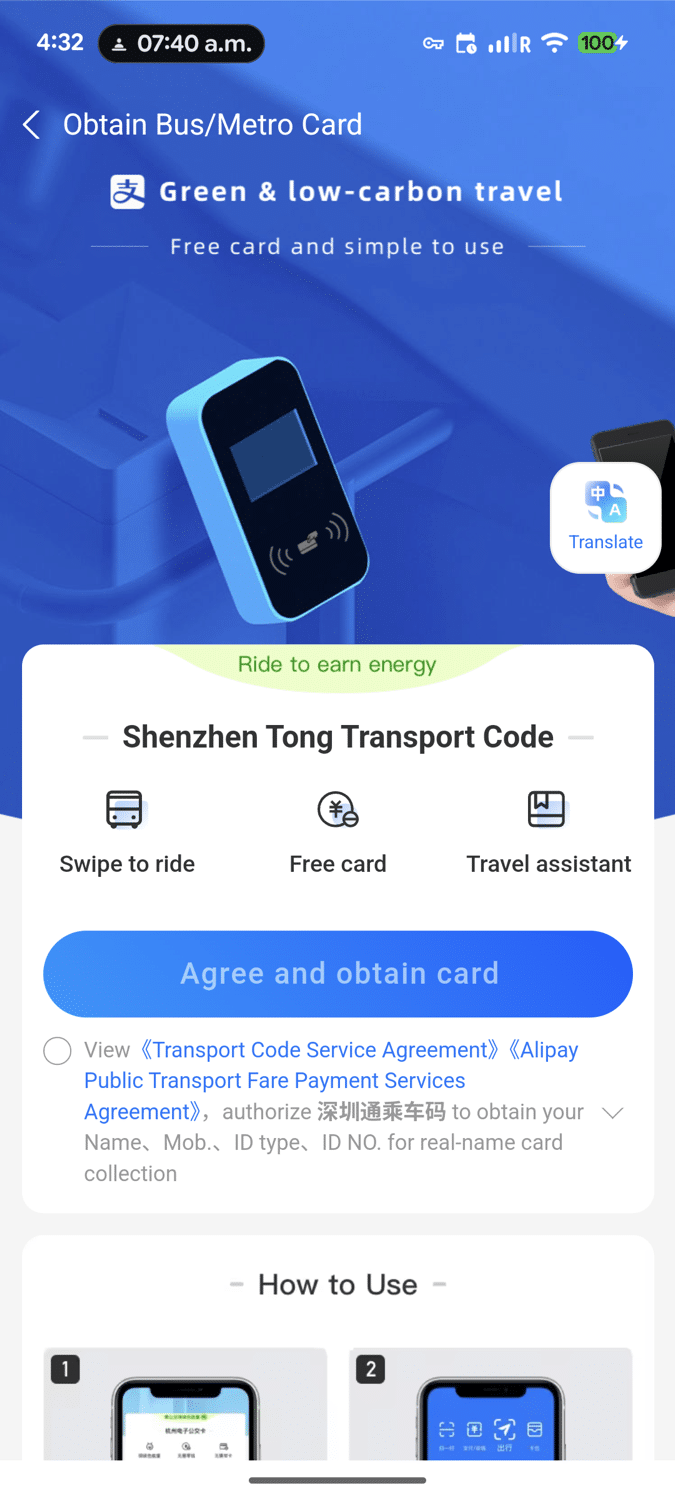
However, not every major city in China currently supports Tap to Ride with international credit cards. In those cases, you’ll need to use Alipay, which is integrated with metro systems across the country and allows you to obtain a digital transit card directly within the app.
To set up a transit card, select the Transport option from the Alipay home screen. From there, choose your city from the drop-down menu at the top, then select the Bus/Metro tab.


After completing a few setup prompts and agreeing to the terms and conditions, Alipay will generate a QR code that can be scanned at metro and bus gates throughout the city. Transit fares will then be automatically charged to the payment card linked to your Alipay account.
Where to Go: Top Destinations in China
China has one of the most diverse landscapes and climate systems in the world because it stretches across multiple latitudes, elevations, and geographic zones.
Over 94% of the population lives in China’s eastern half, where the major megacities are concentrated. This region also offers the strongest tourism infrastructure, making it the most accessible entry point for first-time visitors. Among these, Beijing and Shanghai come to mind as the top choices due to their connectivity, visitor-friendly systems, and higher levels of English usage.
Beijing, the national capital, blends imperial history with modern governance. Travelers come for landmarks like the Forbidden City and easy access to sections of the Great Wall, which are two of the most popular attractions to visit while in China
Shanghai is regarded as China’s financial and commercial center. It is best known for the skyline along the Bund, high-end shopping districts, and a unique contrast between historic neighborhoods and futuristic architecture.

Beyond these two gateways, several secondary cities offer distinct regional experiences:
- Xi’an – An ancient capital and Silk Road hub, home to the ancient Terracotta Warriors.
- Chengdu – Home of the giant pandas, tea houses, and Sichuan cuisine known for bold spice.
- Hangzhou – Centered around West Lake, it combines natural beauty with temples and traditional tea culture.
- Zhangjiajie – A national park region known for towering sandstone pillars that inspired the floating mountains in the Avatar films.
- Shenzhen – A rapidly-growing tech hub that transformed from a fishing village into a global innovation center.
- Qingdao – A coastal city known for its beaches, German colonial architecture, and the famous Tsingtao beer brewery.
Chongqing – China’s largest city by population, Chongqing has gone viral for its cyberpunk-style skyline built vertically into steep mountains, creating a layered, futuristic urban landscape instead of a traditional horizontal urban sprawl.
These destinations are only just a few examples of what China offers. You also have the southern island regions, known for their warm, year-round subtropical climate and scenic beaches.
China Safety & Health Tips
Like any major tourist destination, occasional tourist traps and scams can target unsuspecting visitors. That said, China felt like one of the least intrusive places I have visited when it comes to unprompted solicitation from locals, though they can still occur from time to time.
Be cautious of vendors who may try to slip extra charges through Alipay by targeting unfamiliar travelers who are less comfortable with currency conversion. Since Alipay requires a PIN to confirm payments, always double-check the RMB to CAD conversion before approving any transaction.
In busy tourist areas like The Bund in Shanghai, you will often see photographers offering to take professional photos for a small fee. They may start by quoting a low price, around 25 to 40 RMB ($6), but then take upwards of 20 photos and then claim each one is charged separately, quickly inflating the total cost.
I recommend avoiding these services since the vendors are not upfront with what they intend to charge. If you choose to use one, agree on the total price and number of photos before they start.

One of the biggest safety considerations I noticed while traveling in China was the number of electric scooters. They are one of the primary forms of transportation in many of the country’s largest cities, and because traffic can become heavily congested during peak travel times, riders often use sidewalks and pedestrian walkways to get around. If you’re not expecting it, it can catch you off guard, so it’s important to stay aware of your surroundings when walking.
Because these scooters are electric, they are almost silent. That means you may not hear one approaching from behind or even from the front, especially if you’re focused on your phone for directions. It’s important to stay aware of your surroundings and keep an eye out for scooters, as they are everywhere in busy urban areas.
Surveillance & Police Presence in China
One of the most noticeable surprises in China is the level of police presence in major cities.
In places like Beijing, Shanghai, uniformed officers are often stationed at metro entrances, transport hubs, parks, public squares, and major tourist sites. Subway stations also commonly include security checkpoints with bag screening similar to airport-style checks.
Surveillance is also widespread, with thousands of cameras in virtually every public area and building. I think it’s safe to assume that if you are out in public anywhere, you are almost certainly on camera.
People interpret this differently, but I think these measures largely aim to maintain order in very dense urban environments and provide a visible deterrent in crowded areas.
For most visitors, it’s extremely unlikely to have any direct interaction with police. The overall environment is very orderly, and personally, I found that the visible security presence contributes to a strong sense of safety, with officers mainly focused on public order, rather than engaging tourists.
Conclusion
Traveling to China will likely push you well outside your comfort zone at first. However, if you embrace the unique challenges and quirks that come with visiting the country, you’ll be rewarded with an unforgettable experience filled with incredible history, world-class cuisine, vibrant culture, and breathtaking landscapes.
There are certainly a few hurdles to overcome before and during your trip, but with the right preparation, they’re all manageable. Hopefully, this guide has given you a better understanding of what to expect and helped you feel more confident about planning your journey to China.