
Freedom Mobile Global Roaming: The End of Travel eSIMs?

The rise of travel eSIMs has been one of the biggest improvements for travelers looking to save money abroad. Gone are the days of expensive pay-per-use rates or paying $15 per day for roaming through one of Canada’s Big Three carriers.
Travel eSIMs have made staying connected overseas far more affordable, giving travelers an easy way to access data without spending a fortune.
However, there’s an even better option available to Canadians that I think finally puts the question of how to save on cellular data while travelling permanently to rest.
I’ve been using Freedom Mobile for nearly two years, and it has almost completely erased the need to buy a travel eSIM when I’m abroad. I’d even go as far as to say that Freedom Mobile with Global Roaming is the best all-around cell phone plan in Canada for frequent travelers.
What is Freedom Mobile Global Roaming?
The Global Roaming concept is simple. You get cellular and data roaming in over 120 destinations included in a standard plan with Freedom Mobile. Every Freedom Mobile plan includes talk, text, and data divided into two buckets: one covering Canada, the USA, and Mexico, and another for Roam Beyond destinations.
Canada + U.S. + Mexico
- In Canada: Unlimited Canada-wide calling, plus calls to the U.S. and Mexico, with unlimited incoming calls.
- In the U.S. or Mexico: Unlimited domestic calling within the country you’re visiting, plus calls to Canada and unlimited incoming calls. Calls between the U.S. and Mexico are charged on a pay-per-use basis.
- A set amount of monthly data useable in Canada, U.S., and Mexico
Roam Beyond (120+ destinations)
- Unlimited talk includes unlimited domestic calls within the included destinations, unlimited calls to Canada from those destinations, and unlimited incoming calls. Calls between included destinations are charged on a pay-per-use basis.
- An allocation of data that resets monthly, valid in any of the 120+ included destinations
- Unlimited Text includes unlimited worldwide text, picture, and video messaging.
Global Roaming Plans
Freedom offers a variety of plans, similar to other wireless providers. Each plan includes an allocation of data divided between usage in Canada, the U.S., and Mexico, as well as international roaming through Roam Beyond destinations. For example, the $50/month plan includes 175 GB of data usable in Canada, the U.S., and Mexico, along with an additional 10 GB monthly data bucket for Roam Beyond destinations.
As one of the smaller players in Canada’s telecom market, Freedom Mobile often uses aggressive promotions to attract customers away from the Big Three carriers. By keeping an eye out for limited-time offers, you can often find plans that are significantly better than its standard pricing.
Roam Beyond Destinations
Below are the current 120-plus destinations included in Roam Beyond. This list includes many of the most popular tourist destinations in the world, with North America and Europe offering extensive coverage.
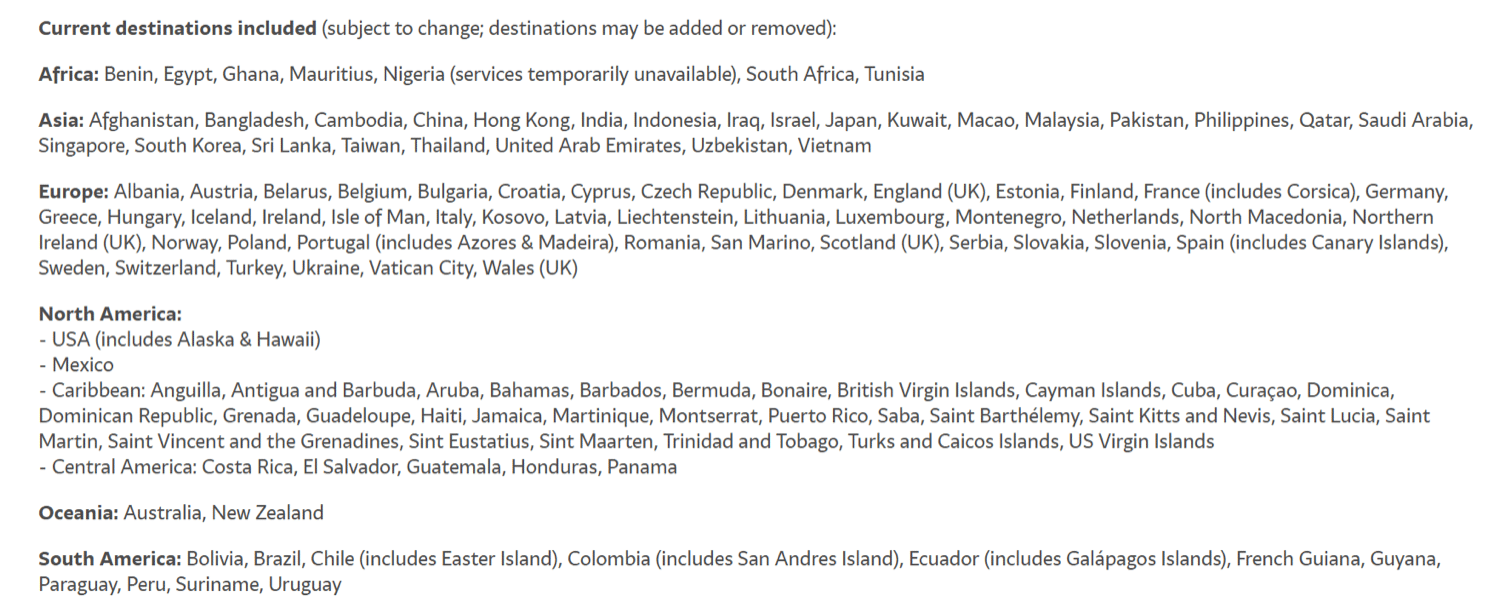
Although the coverage for most regions is excellent, Africa is without question a weak point. One of the few occasions I’ve had to purchase a separate travel eSIM was for when my wife and I went to JW Marriott Masai Mara Lodge in Kenya.
However, I think the included countries should cover the majority of popular destinations for Canadian travelers. Occasionally needing to purchase a standalone eSIM for a country that isn’t included is a much better situation than having to buy, manage, and swap between new eSIMs for every country or region on each trip.
Roam Beyond Passes and Travel eSIMs
While this likely won’t apply to many users, those on legacy Freedom plans without Roam Beyond data can purchase 30-day passes. However, neither option is particularly attractive at $30 for 5 GB or $50 for 10 GB, especially when you can sign up for a new phone plan for a similar price.
Freedom also sells standalone travel eSIMs that work similarly to those offered by providers such as Airalo and Saily. Freedom eSIMs may offer more flexibility for some travelers, as they work in over 120 countries, while most standalone eSIMs from Airalo and Saily are typically limited to specific countries or regions.
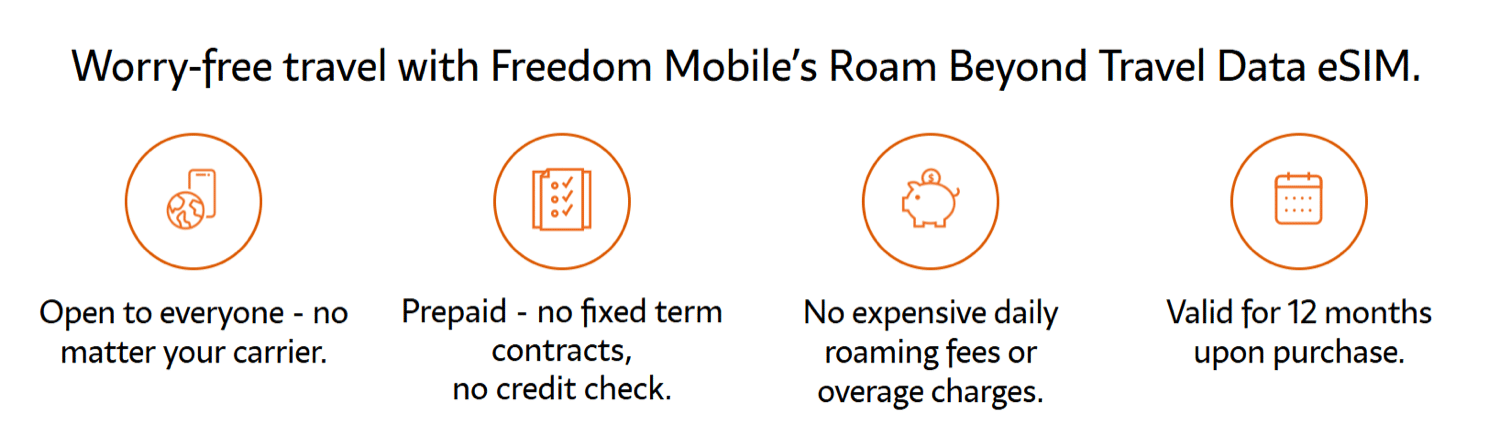
I think Freedom’s pricing for its standalone eSIMs is competitive, especially for those planning a round-the-world trip or expecting to visit multiple countries and regions throughout the year, as the plans are valid for a full 12 months.
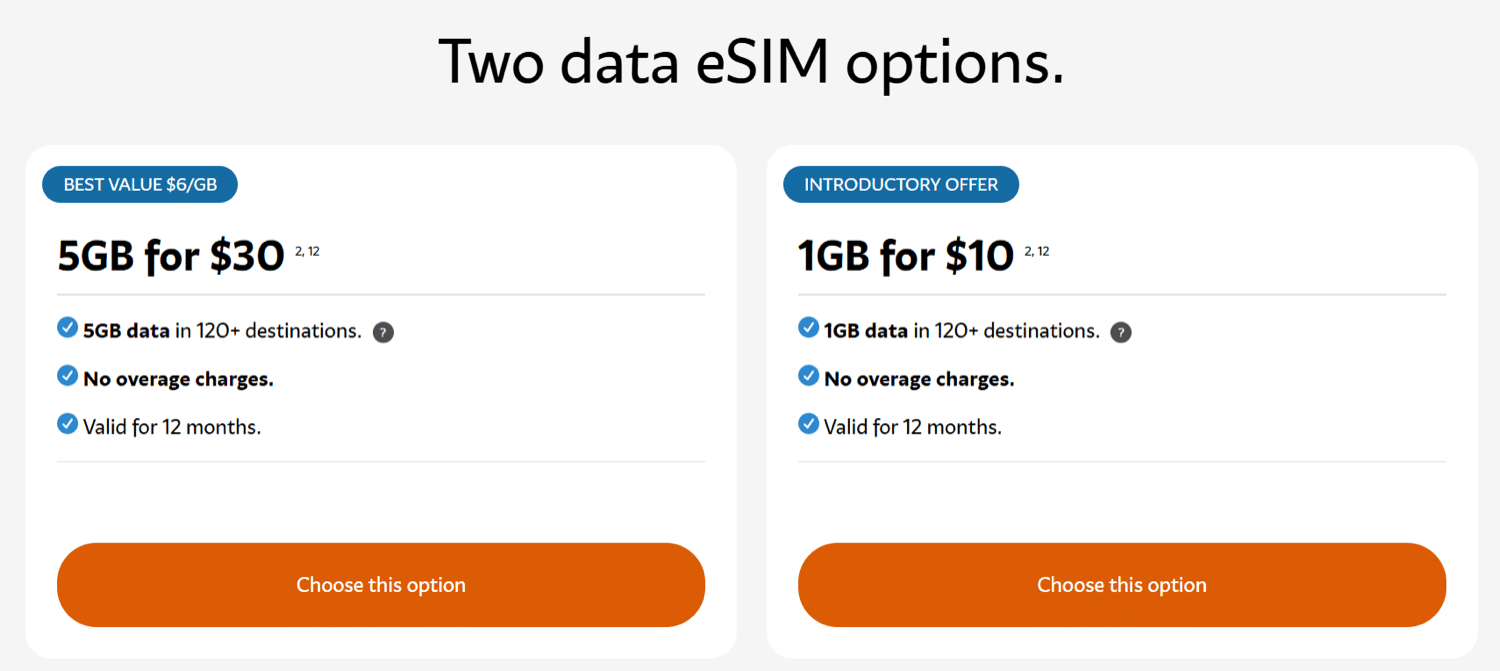
You don’t need to have a Freedom Mobile plan to use a travel eSIM, so it’s worth comparing prices to other providers at the very least.
Other Benefits of Global Roaming
One of the biggest advantages of using Freedom Mobile abroad is that, unlike data only eSIM providers, Freedom Mobile’s Global Roaming allows you to use your phone normally, including making and receiving calls and sending and receiving text messages.
This has come in handy countless times when I’ve found myself halfway around the world and needed to receive a 2FA text from a bank to log into an account. There’s no need to juggle SIM cards or worry about which number is currently active. Plus, while I don’t use it as often, having unlimited local calling in a foreign country can also be incredibly useful.
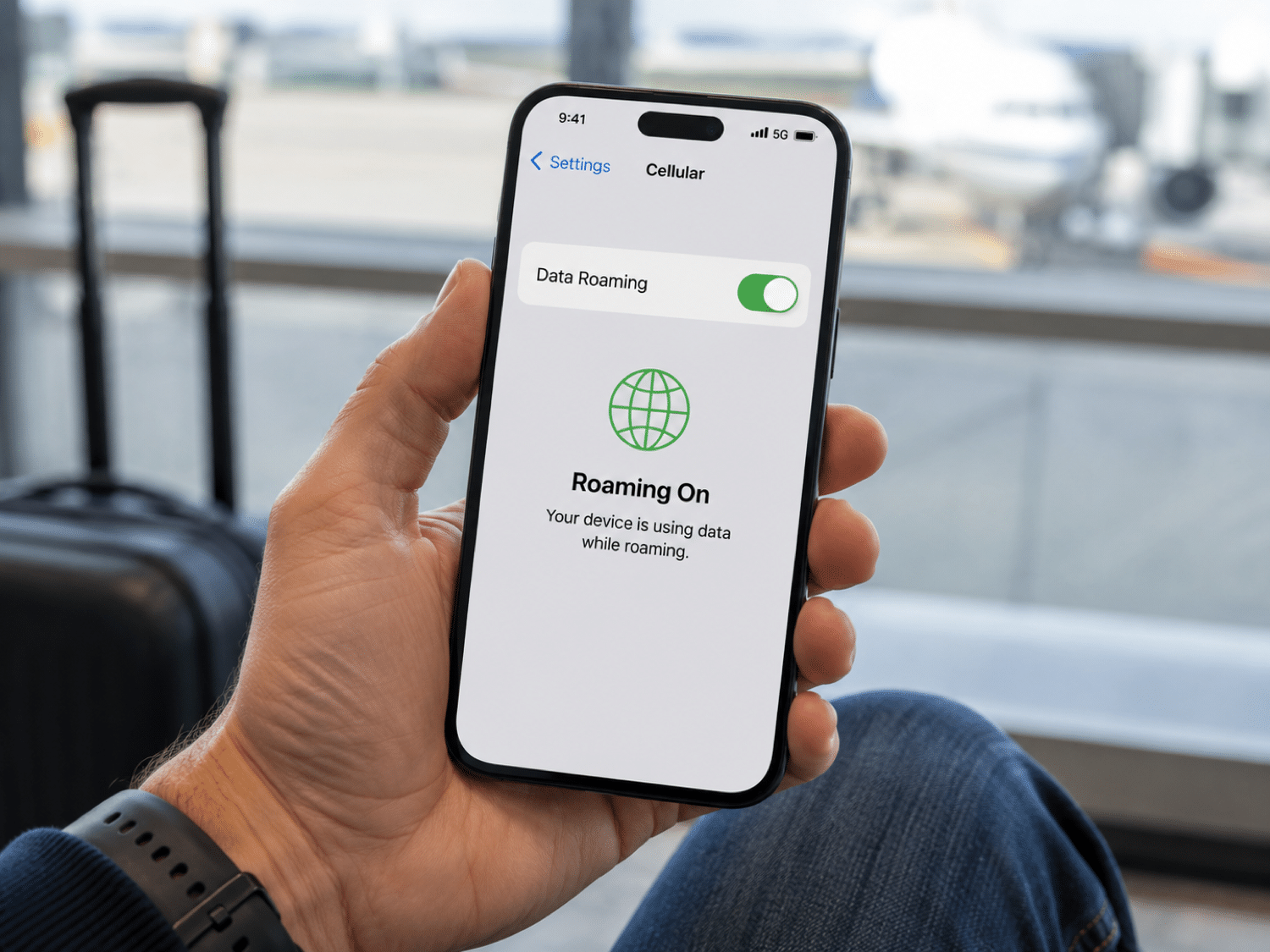
There’s also something incredibly liberating about just turning on data roaming and never having to think about it again. You can hop from country to country without constantly managing SIM cards, installing eSIMs, or figuring out which plan to use next. You phone will automatically connect to whatever partner network Freedom has an agreement with in that country and operate as normal
Finally, and perhaps most importantly, there’s an immense sense of satisfaction to be had in knowing that you’re not paying even a single dime to the Canadian mobile cartels of Rogers, Bell, or Telus every month. That alone could be reason enough to switch; plus supporting a company that actually seems interested in offering good value rather than trying to rip off its customers at every turn is the cherry on top.
Daily Use of Freedom Mobile in Canada
Okay – I’ve spent the entirety of this article talking about using Freedom Mobile abroad, but what’s it like to use Freedom Mobile on a daily basis in Canada?
I’ve used all of the major Canadian telecom carriers at various points over the years, and based on my experience, Freedom Mobile is now largely indistinguishable from the others. Some carriers may have certain pockets where their coverage is stronger or weaker, but as someone living in Metro Vancouver, I’ve found Freedom’s service to be reliable and more than adequate for everyday use, with very few issues.
If you’re outside Freedom Mobile’s service area, your phone will automatically connect to a partner network, allowing you to stay connected without interruption, including in rural areas.
Freedom Mobile once had a pretty poor reputation for unreliable cell service, but since the company was acquired by Québecor, it has made significant improvements to its network and overall service.
For anyone who still thinks Freedom Mobile is vastly inferior to the legacy carriers, that reputation is largely a holdover from the past. Though once a company develops a poor reputation, it can take years, if not decades, to shake it, even after the underlying product has improved substantially.
You could almost compare this to the still-common perception that American Express has poor acceptance in Canada. That may have been true years ago, but it hasn’t really been the case for a long time. Yet these misconceptions are incredibly difficult for companies to overcome once they’re out in the wild.

That’s not to say Freedom Mobile is flawless. If there’s one major downside, it’s that mobile signal can be really bad inside large residential towers and office buildings. This can be a problem with other carriers too, but I’ve noticed that it’s especially poor with Freedom.
Fortunately, this isn’t a huge issue since all Freedom Mobile plans support Wi-Fi calling. If you have reliable Wi-Fi where you spend most of your time, you likely won’t notice the weak indoor signal.
Comparison to Other Roaming Services
Freedom Mobile has been an innovator and leader in bringing affordable worldwide roaming to Canada, forcing the competition to respond. But in what is hardly surprising news, the big carriers’ roaming options still range from hilariously bad to downright offensive.
The best outcome has been that now nearly all plans from the big 3 include roaming in the U.S. and Mexico with enough data that should be sufficient for most users.
However, when it comes to roaming beyond North America, the major carriers are still lagging behind. While you can still purchase travel passes or roaming add-ons from the legacy carriers, travel eSIMs have largely made these options obsolete.
For example, Rogers charges $70 for a 14-day European travel pass, which lets you use your existing data allowance abroad. That’s on top of your regular monthly bill. By comparison, I found a suitable eSIM through eSIMDB offering 20 GB of data for 14 days for around $21.
And remember, many of Freedom Mobile plans include 10 GB of monthly international roaming at no additional cost.
If you want full international roaming with one of the legacy carriers, you’ll need to subscribe to one of their most expensive monthly plans, which start at around $85 per month. Rogers, Bell, and Telus all offer international roaming, but their coverage only extends to only around 65 countries, roughly half the number available with Freedom Mobile.
Finally, if you’re only an occasional traveler and don’t need comprehensive international roaming, a standalone eSIM may be enough. For example, if you only take one trip to Mexico each year, a Mexico-only eSIM could be a more suitable and affordable option. However, remember that you’ll typically give up access to calling and texting services when using these SIMs.
Conclusion
Thankfully, the days of Canadians paying exorbitant prices for roaming packages are behind us. For years, we’ve sung the praises of standalone data eSIMs and recommended using Google F for those who need a working phone number.
However, since Freedom Mobile introduced its Global Roaming plans, Google Fi has become a distant memory, and I rarely need to purchase an eSIM anymore. Better yet, staying connected abroad is no longer something I have to think about. In most cases, wherever a flight lands, I know I’ll have a working mobile connection without spending any extra money, time, or effort beyond my regular monthly bill.