
The Data Architecture Gap That Hotel AI Procurement Isn’t Pricing In

The Architectural Argument
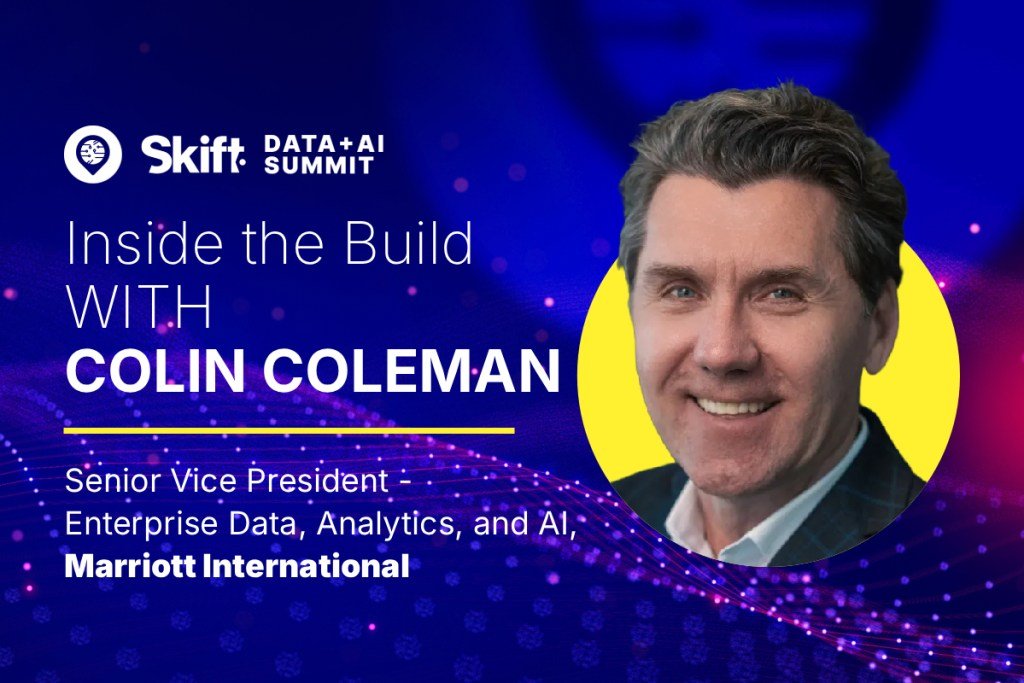
Colin Coleman, Marriott’s Senior Vice President of Enterprise Data, Analytics and AI, is running that build across 9,900 properties and more than 30 brands, and his central argument at Skift Data + AI Summit on June 3 in New York is architectural rather than aspirational. The advantage, Coleman argues, is not the volume of data — 283 million Bonvoy members, decades of first-party signals spanning the full guest journey — but the connected intelligence layer Marriott is constructing on top of it, a foundation that makes every new AI application deployed across the portfolio start smarter than the last one rather than starting from scratch.
Every GenAI tool inside Marriott draws from the same connected layer linking customer, property, and owner data, which means the second tool is better than the first and the tenth is dramatically better than the second.
The implication for the rest of the industry is uncomfortable and worth sitting with. Hotel companies buying AI capability in 2026 without building the data services layer underneath it are committing to tools that will underperform and eventually need replacing. Coleman is making that argument from inside the build, which gives it credibility but also raises the question the room needs to press him on directly.
The Frameworks He’s Bringing
Two frameworks from inside the Marriott build matter for anyone evaluating hotel technology investments right now.
The first is the intelligence layer versus the point solution — most hotel AI investment gets evaluated deal by deal, does this pricing tool improve RevPAR, does this chatbot reduce call volume, does this personalization engine lift conversion, and the question Coleman is pushing is whether those tools compound or whether each deployment starts from zero and the cost of integrating the next one keeps rising. Companies treating each AI buy as an isolated decision are accumulating technical debt that doesn’t appear on the procurement spreadsheet.
Two architectures for hotel AI procurement: the point solution model versus the intelligence layer model, comparing integration cost curves and outcomes.
What most hotels are buying
Point Solution Model
1
Each tool evaluated in isolation. Pricing engine, chatbot, personalization — separate procurement, separate data.
2
Every deployment starts from zero. No shared data layer means no compounding between tools.
3
Integration cost rises with each addition. Technical debt accumulates invisibly outside the procurement spreadsheet.
4
Tools underperform and eventually need replacing. The stack becomes a collection of siloed bets.
Cost per new AI tool
Rising cost, no compounding.
What Marriott is building
Intelligence Layer Model
1
Central data layer connects customer, property, and owner signals. One foundation serves every AI application.
2
Every new tool starts smarter than the last. Connected context means compounding intelligence across deployments.
3
Integration cost decreases with each addition. The shared layer absorbs complexity individual tools don’t have to carry.
4
Human-AI design constraint built in. Organizational infrastructure — literacy, decision rights, champion networks — runs alongside the technical build.
Cost per new AI tool
Declining cost, compounding returns.
The second is the human-AI design constraint — Coleman’s operating principle is that AI earns its place at Marriott by enabling associates to spend less time on repetitive tasks and more time on guest experience, which means organizational infrastructure running alongside the technical infrastructure, AI literacy programs for on-property associates, decision-rights frameworks clarifying what AI can and cannot act on alone.
The Question Worth Pressing
Here is the tension Skift will press directly. Marriott’s data advantage is 283 million loyalty members and a Google Cloud partnership to lean on. Most hotel companies don’t have that. Independent operators, regional chains, mid-scale brands — they are working with a fraction of the data and a fraction of the engineering resources, and if the lesson from Marriott’s AI build is “start with your data foundation,” the honest follow-up question is: what does that mean for the operator who doesn’t have one? Is Coleman’s framework a roadmap that scales to a 50-property portfolio, or is it a description of a moat that only looks like advice?
Coleman joins Joff Romoff, Global Head of Travel and Hospitality at Google Cloud, with Seth Borko, Skift’s Head of Research, moderating. A limited number of seats remain for Skift Data + AI Summit 2026.
↔️ Plans not final? Reassign tickets later.
🧾 Invoice or wire needed? events@skift.com
FOR TEAMS ATTENDING TOGETHER
Group Tickets
FOR ONE ATTENDEE
Solo Ticket
For single-ticket purchases only.
$995