

Transit Hotels vs. Airport Hotels: When Does It Make Sense?

So you’ve booked a connecting itinerary with a long layover, and now you’re staring down the barrel of eight-plus hours in an airport terminal. It’s 2 AM, the lounges are closed, and the only food option is a vending machine that’s been collecting dust since the last World Cup. You need sleep. You need a shower. You need an actual bed.
Depending on the airport where you find yourself, this is where the choice between a transit hotel and an airport hotel comes in. Despite what you might think, they’re not the same thing. Each comes with a very different set of trade-offs on price, convenience, and whether you can even use your loyalty points.
Most importantly, let’s break down what they are, the differences between the two categories of hotels, and when it makes sense to book one over the other.
What is a Transit Hotel?
So a transit hotel is the kind that’s located next to the terminal and not inside it, right? Wrong.
Despite “airport hotel” immediately evoking the idea of a hotel physically inside an airport, the proper term for your place to stay inside the secure, airside section of the airport is “transit hotel”.
Think of the nomenclature the same way you’d think of airport lounges and duty-free shops: it’s past security, it requires a boarding pass to access, and it exists entirely for the convenience of passengers who are mid-journey and don’t want to leave the terminal. Hence why it’s labelled as “transit.”
These abodes are designed for travellers in transit who want to grab a few hours of sleep, take a shower, and recharge before their next flight, without having to deal with the hassle of clearing customs, collecting luggage, or with ground transportation.
Some of the better-known examples of transit hotels include the Oryx Airport Hotel in Doha’s Hamad International Airport, which our editor and co-founder Josh visited and found adequate, as well as the Aerotel and YOTEL brands you’ll find scattered across Europe and Asia, focused on high-density business destinations.
Benefits & Drawbacks of Transit Hotels
The upside is obvious: proximity and minimal disruption. You don’t have to worry about clearing immigration, finding a taxi, navigating an unfamiliar city at 3 AM, or – and this is the big one – whether you have enough time to get back through security before your next flight. For connecting passengers with tight layovers, transit hotels can be the difference between a miserable experience and arriving at your destination reasonably rested.
The downside? Cost. Transit hotels know they have a captive audience, and they price accordingly. A basic room at the aforementioned Oryx Doha, for example, can run a cool $400 CAD for a single night in a utilitarian room that certainly was not up to the par of many of the luxury-branded hotels in the Gulf States. If you’re staying in a transit hotel, you’re exchanging money for convenience.
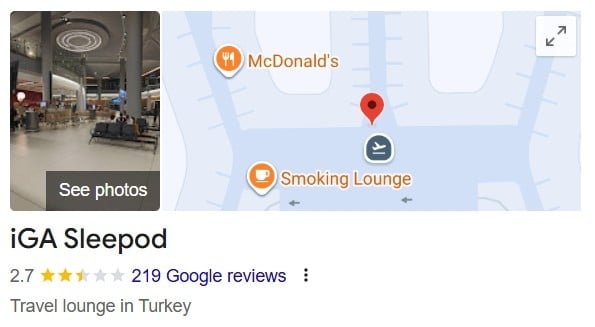
For example, at Istanbul airport, prices routinely run north of $300. The only alternative to YOTEL is the iGA sleep pods, which cost up to 26 euros, or over $40 CAD, for the following superlative experience:
The other issue, and this is a big one for the Miles and Points crowd, is that many transit hotels are not affiliated with any major hotel loyalty program. They’re often independent operators or niche brands, which means you can’t earn Marriott Bonvoy points, redeem Hilton Honors free night certificates, or benefit from any elite status perks.
There can, of course, be exceptions to this rule, but it is a rarity to find a major loyalty program affiliated with a transit hotel. Thus, you’ll probably turn to a program like Scene+ or TD Rewards if you want to use points to save money on your stay at a transit hotel.
What is an Airport Hotel?
An airport hotel is a lodging located near the airport, typically in the surrounding commercial or industrial district. It can be located in the airport at some destinations, but will always be landside and will not require the guest to clear security to enter it; however, they will need to clear customs to enter the country to stay at an airport hotel if they are on a layover.
You know the type: the Marriotts, Hiltons, and Holiday Inns clustered around airport access roads, usually offering a complimentary shuttle bus to and from the terminal. They also have breakfast buffets of indeterminate origin and tepid heat, and the same bland, modern-chic but unplaceable style (if they’re renovated, as many are decrepit).
These exist primarily to serve business travellers who need to be close to the airport or industrial areas without paying city-centre prices, and leisure travellers who have early morning departures or late arrivals and want a bed that isn’t an airport bench.
Benefits & Drawbacks of Airport Hotels
The biggest advantage of airport hotels is price. You’re almost always going to pay less for a room at an airport-adjacent hotel than at a transit hotel inside the terminal. And because many of these properties are operated by major chains, you can book them with points, earn loyalty credits, and take advantage of elite status benefits.
For example, if you hold a Marriott Bonvoy free night certificate, or even just a small amount of points, you could cash in on a deal such as this PointSavers redemption at the Fairfield by Marriott Inn & Suites Toronto Airport that is much more reasonable than the rates at the in-terminal Sheraton Gateway Hotel at YYZ.

That said, not every hotel near an airport is part of a major chain. Plenty of airport-adjacent properties are independent or belong to smaller regional brands, which means no loyalty points, no status recognition, and potentially inconsistent quality. But, ultimately, you’re staying near the airport. You’re not expecting a resort, are you?
The drawbacks are mostly logistical. You need to clear customs and immigration on an international itinerary, collect your bags, find the shuttle, wait for it (anyone who’s stood outside at YYZ in January or waited for a shuttle in Dubai’s 45-degree heat knows the drill), and then reverse the entire process on the way back. For your departure, you’ll have to consider clearing security again. This can easily add an hour or more.
Worse yet, airport hotels also tend to be in areas with limited food and beverage options, and because they know they have a captive audience (often on expense accounts), what their hotel restaurant provides is often of limited quality and high price. Our Frugal Flyer team shelled out over $18 for some of the worst Old Fashioneds we’ve ever had at a Hilton in Mississauga.
When Does It Make Sense To Book a Transit Hotel vs. an Airport Hotel?
Alright, so when should you actually opt for a transit hotel over the cheaper airport alternative? It comes down to a few factors.
The first and most obvious is when your employer is picking up the tab. If work is covering the expense, the premium for a transit hotel is easy to swallow, and the convenience of staying airside can actually make you more productive.
The second is when you genuinely don’t have time for the round trip. If your layover is six to ten hours and you factor in immigration, luggage, shuttle logistics, and re-clearing security, you might only get three or four hours of actual rest at an airport hotel. A transit hotel eliminates most of that overhead.
Third – and this is easy to overlook – is when visa or entry requirements would make leaving the airport complicated. Some countries require transit visas even to exit the terminal, and the process can eat into your layover time or add unexpected costs.
Though we at Frugal Flyer should note: we absolutely hope you’re not going to countries without figuring out immigration status first. Don’t bring up this article if you get detained in Turkmenistan (which, interestingly, Turkmenistan is often a transit point for budget-conscious travelers flying from the United Kingdom to India, and you should never try to leave the airport without permission).

In other cases, the security screening for re-entering the airport is notoriously long (positioning yourself at a hub with efficient security helps, but isn’t always an option). If leaving airside means navigating a bureaucratic maze, a transit hotel might be the path of least resistance.
Ultimately, it’s a question of how much your time is worth. Transit hotels are a convenience premium. Airport hotels are a value play. Neither is universally better; it just depends on your layover length, your itinerary, your budget, and whether you’d rather optimize for rest or for your wallet.
Conclusion
The transit hotel vs. airport hotel decision doesn’t have a universal right answer. Transit hotels win on convenience but lose on price, and oftentimes amenities. Loyalty availability is hit-or-miss, and often at a significant premium, even when an option. Airport hotels win on cost and the ability to actually use your points, but demand more of your time and energy, which shouldn’t be underestimated on a tight itinerary.
For most leisure travellers with the gift of time, the airport hotel is the smarter play – especially if you can book one on points or with a free night certificate. But when time is tight, the visa situation is complex, or someone else is footing the bill, the transit hotel earns its keep.
Until next time, sleep well wherever you land.