Travel’s Climate Gap Is Growing. So Is the Opportunity.

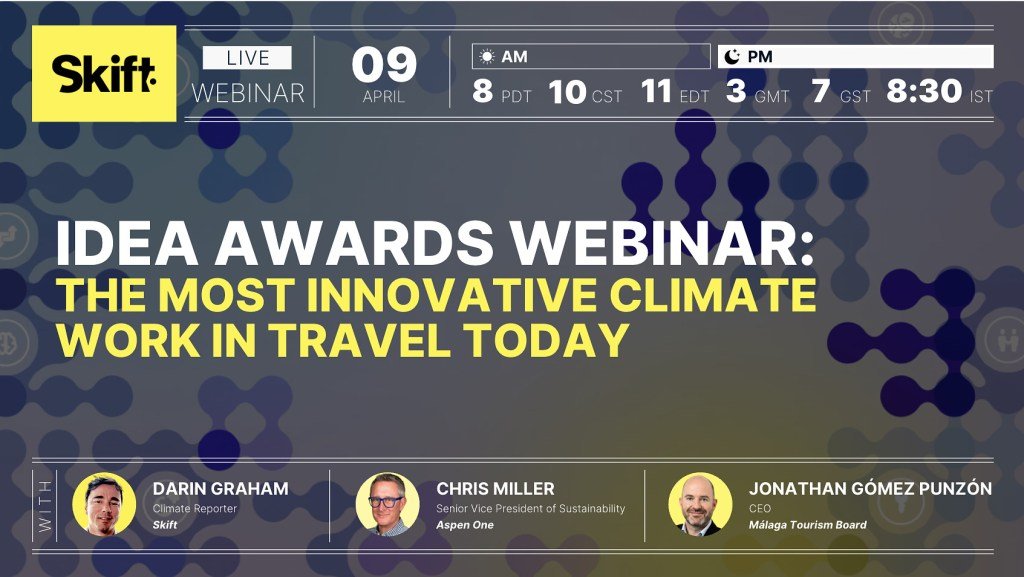
At the recent Skift IDEA Awards webinar, Skift Climate Reporter Darin Graham spoke with IDEA Awards judges Chris Miller, SVP of Sustainability at Aspen One, and Jonathan Gómez Punzón, CEO of the Málaga Tourism Board.
Tourism emissions are growing at 3.5% annually, while global emissions rise closer to 1%. On current trajectories, travel-related emissions could double within the next two decades. At the same time, extreme weather is increasing operating costs and disrupting demand, hitting both revenue and cost structures. Climate risk and energy insecurity are colliding in real time.
A group of companies has already moved on this. They are redesigning energy systems, building water resilience, and reducing exposure to volatile costs. The result is a clear structure for lower operating costs and stronger long-term stability, with growing investor interest following closely behind.
If you have already done meaningful work in sustainability, the advantage exists. The next step is making it scalable and visible.
Climate Work Is Driving Financial Outcomes
At Aspen One, all-electric buildings are part of a long-term cost strategy. Their local utility moved from 5% to 90% clean energy over fifteen years, while maintaining electricity rates below national averages.
Another example shared during the session showed a fully renewable hotel operating at roughly $5 per room in energy costs, compared to around $15 in the same market.
This energy security focus is cropping up in more and more portfolios.
It is likewise cropping up in destinations. Málaga, the popular beachgoer destination facing ever-higher temperatures, is attracting investment tied directly to renewable infrastructure and climate readiness. The city has spent years building integrated urban climate systems, such as natural cooling zones and funneling almost entirely recycled water into the region’s 70+ golf courses.
“We are experiencing a boom of investors because they know how ready our area is for these challenges,” said Gómez Punzón. “Most investment firms coming to us say they have done the research to know that we are getting very serious on climate adaptation for the near future. We may be a destination management organization, but we do also take care not only of promotion but also about governance in the city, bringing luxury investors for visits and demonstrating we are the only place in the world doing this, and creating suggestions for the mayor and for the region on how to tackle potential unexpected problems.”
Málaga Tourism Board, Aspen One and many others are shifting the focus from climate warning narratives to actionable steps to provide lower-risk investment opportunities in environments with more predictable operating conditions.
Scale Is Coming From System-Level Change
The tools are already in place: renewable energy, electrification, storage, water recycling, real-time monitoring. According to Miller, the barrier is adoption.
“From a technology perspective, the good news is that we really do have all the tools we need to do this today,” Miller said. “We’ll see the cost of that technology—of wind, solar, EVs, heat pumps—decrease as well. It’s a super good news story. We don’t need to wait fifteen years for the technology to solve so many of these problems. They’re in hand, they’re scalable. We’re rolling them out in our hotels and on our mountains. Really, the job to be done is to speed up adoption, encourage as many others to join us as we can.”
Miller pointed to a shift away from company-level action toward system-level influence. Progress depends on shaping energy systems, policy environments, and infrastructure networks.
Aspen helped transform its regional energy grid. Málaga is aligning startups, public authorities, hotels, and cruise operators to redesign mobility, water use, and energy systems in parallel.
Travel sits at the center of a network connecting resorts, attractions, local communities, and government. It shapes local economies and drives infrastructure decisions. That position creates leverage most industries do not have.
The Visibility Barrier
Gómez Punzón and Miller agree that the industry still lacks clear ways to showcase what is working. This slows replication and limits recognition of proven models. For companies already ahead, this creates a missed opportunity.
Visibility attracts capital. It brings partners and positions companies as benchmarks that others follow.
If You’ve Built Climate Advantage, Show It
The outcomes are already clear: lower costs, stronger resilience, increased investor interest, and better positioning in volatile markets.
What many companies lack is recognition that reflects the scale of their work.
Skift IDEA Awards exist to surface it, highlighting execution, measurable outcomes, and models others can learn from.
If you’ve invested in climate solutions or built something that moves the industry forward, this is where that advantage becomes visible.