Web Summit Rio and the Next Boom: How Tech Tourism Could Transform Rio’s Travel Industry | Focus

Rio de Janeiro has always known how to host the world. Carnival, New Year’s Eve on Copacabana, Rock in Rio, football finals, beach culture, samba, architecture, food, nightlife and mountain-meets-ocean drama have made the city one of the most emotionally powerful destinations on earth.
But Web Summit Rio adds something different.
It does not just bring tourists. It brings decision-makers. It brings founders, investors, executives, developers, media, creators, policymakers and global companies who arrive with laptops, budgets, networks and influence. They do not only book hotel rooms. They test a city’s airports, restaurants, transport, connectivity, hospitality standards, safety systems, coworking spaces, cultural experiences and business infrastructure.
That makes Web Summit Rio more than a technology conference. For the travel and tourism industry, it is a live stress test, a showcase and a commercial accelerator all at once.
The projected impact could be enormous. If Rio uses the event well, Web Summit Rio can help move the city from a leisure icon to a year-round business and innovation destination — the kind of place where people come for a conference, stay for the culture, return for holidays and eventually invest.
From Beach Destination to Business Travel Magnet
Rio’s tourism brand has always been emotional: beaches, beauty, music, nature, celebration. Web Summit Rio introduces a more strategic layer: business travel.
That matters because business travelers behave differently from traditional leisure tourists. They often spend more per day, travel outside peak holiday windows, book premium accommodation, use restaurants and transport heavily, and extend trips when the destination is attractive. In Rio’s case, the “bleisure” opportunity is obvious. A founder flying in for three conference days may add a weekend in Ipanema. An investor may bring a partner. A speaker may turn a panel appearance into a week of meetings. A journalist may write not only about the event, but about the city.
This is where Web Summit Rio becomes powerful for tourism. It gives Rio a recurring global business reason to visit. The city no longer has to rely only on seasonal leisure demand. It can build a new travel rhythm around technology, entrepreneurship and international networking.
For hotels, airlines and travel platforms, this means a more valuable visitor mix. For Rio, it means a chance to reposition itself as Latin America’s most exciting meeting point between business and culture.
Airlines: The First Winners of Conference-Led Demand
The first companies to feel the effect of a major international event are airlines.
LATAM, Gol, Azul and international carriers serving Brazil all stand to benefit from Rio’s growth as a tech-event destination. Major conferences create predictable demand: attendees know the dates months in advance, companies send teams, investors travel in groups, and media outlets book early. That can support stronger load factors, higher-yield fares and greater justification for route expansion or frequency increases.
LATAM’s broader Brazil expansion shows how airlines are already responding to stronger international demand. As Brazil becomes more visible globally, events like Web Summit Rio can help airlines see Rio not only as a leisure gateway, but as a business route with strategic value.
This is important because route connectivity shapes destination competitiveness. A city can have great hotels and attractions, but if it is hard or expensive to reach, it loses events, investors and tourists. Web Summit Rio gives airlines more evidence that Rio can generate high-value travel demand beyond holidays and Carnival.
The long-term opportunity is not just more flights. It is smarter travel packaging: conference fares, corporate bundles, stopover campaigns, loyalty promotions and partnerships with hotels, rideshare services and experience platforms. Airlines that treat Web Summit Rio as a recurring business-tourism anchor can capture demand before, during and after the event.
Hotels: The Rise of the “Conference-Plus-Culture” Guest
For hotels, Web Summit Rio is not just another occupancy spike. It is an opportunity to rethink the guest.
A tech conference attendee may want fast Wi-Fi, flexible check-in, quiet work areas, meeting rooms, airport transfers, translation support, wellness options, secure transport and curated local experiences. They may want to take investor meetings over breakfast, record a podcast from the lobby, host a private dinner, or work from the hotel for three days after the event.
This creates an opening for hotel groups such as Accor, Marriott, Hilton, Hyatt, Fasano and local boutique operators. Rio’s luxury and lifestyle hotel scene can package itself around a new kind of traveler: the executive who wants efficiency without losing the magic of the city.
Accor is especially interesting because of its strong Brazil presence and its luxury positioning in Rio. Properties such as Fairmont Copacabana and lifestyle-led hotel concepts are well placed to capture travelers who want both business convenience and a destination experience. The projected tourism impact is not simply higher room nights; it is higher-value room nights.
Hotels can also become mini-conference ecosystems. During Web Summit Rio week, the most successful properties will not only sell beds. They will host side events, investor breakfasts, startup dinners, brand activations, media lounges and founder meetups. In many global conference cities, the “real conference” often happens after the official agenda ends. Rio’s hotels can own that layer.
Airbnb and Short-Term Rentals: Opportunity With Tension
Short-term rental platforms such as Airbnb will also benefit from Web Summit Rio’s growth, particularly because conference demand often exceeds the traditional hotel footprint or pushes visitors toward specific neighborhoods.
For startup teams, creators and small companies, apartments can be more affordable and flexible than hotels. A team of five may prefer a shared apartment in Barra, Ipanema, Leblon, Botafogo or Copacabana. Investors and executives may want luxury homes for private meetings. Digital nomads may extend their stay and use the event as a reason to test Rio as a remote-work base.
This can spread tourism income beyond hotel corridors and into residential neighborhoods, restaurants, gyms, cafés, coworking spaces, laundry services and local transport.
But the opportunity comes with tension. Around the world, short-term rentals raise questions about housing affordability, regulation, neighborhood disruption and tax fairness. Rio will need to balance growth with local protection. The best outcome would be a managed model: transparent rules, safety standards, tax compliance and incentives for tourism income to benefit communities rather than simply extract value from them.
If handled well, Web Summit Rio could help Rio build a more mature short-term rental strategy — one that supports business tourism without damaging residential life.
Online Travel Agencies: Decolar, Booking.com and the AI-Powered Trip
The biggest change in travel may not happen at the airport or hotel. It may happen before the traveler arrives.
Online travel agencies and platforms such as Decolar, Despegar, Booking.com, Expedia, Hopper, Kayak and Google Travel are moving toward AI-assisted planning. The traveler no longer wants to search through hundreds of options manually. They want a trip that organizes itself: flight, hotel, transfer, restaurant, event ticket, coworking space, local experience and weekend extension.
Web Summit Rio is a perfect use case for this.
Imagine a founder from London booking a Rio trip. An AI travel assistant could recommend flights based on arrival time, suggest hotels near Riocentro or near the beach depending on preference, add airport transfers, reserve dinner near Ipanema, suggest meetings in coworking spaces, recommend a Saturday visit to Santa Teresa, and offer a Sunday favela-led cultural tour or Tijuca Forest hike.
That is the future of travel commerce: not isolated bookings, but connected trips.
Decolar is particularly relevant because it is one of Latin America’s most important travel technology companies. Its regional knowledge, Portuguese-language strength and understanding of Brazilian consumer behavior give it an advantage over purely global platforms. If Web Summit Rio increases inbound business travel, companies like Decolar can create packages specifically for event travelers, startups, investors and corporate teams.
Booking.com also has a major role to play. Its global inventory and AI-driven personalization can help international visitors discover Rio beyond the obvious choices. The more travelers seek authentic, flexible and experience-rich trips, the more platforms will compete to own the full Rio journey.
Amadeus and the Invisible Infrastructure of Tourism
Many travelers have never heard of Amadeus, but companies like it help power the travel industry behind the scenes. Travel technology infrastructure connects airlines, hotels, travel sellers, corporations and booking systems. As travel becomes more personalized and AI-driven, this invisible layer becomes even more important.
For Rio, the implication is clear: a successful tourism boom depends on digital infrastructure as much as physical infrastructure.
Visitors need accurate availability, dynamic pricing, smooth booking, reliable payments, real-time disruption alerts, multilingual support, biometric or faster airport processing, and better integration between flights, hotels and ground transport. Web Summit Rio brings exactly the kind of audience that notices friction. A delayed airport transfer, weak Wi-Fi, confusing booking flow or poor customer support experience can damage the city’s reputation among influential travelers.
The upside is that the same audience also accelerates innovation. If travel-tech companies, airlines, hotels and tourism boards use Web Summit Rio as a laboratory, Rio could become a testbed for smarter tourism systems: AI concierges, dynamic visitor flows, multilingual chat support, digital safety tools, event mobility planning and personalized destination marketing.
Local Experiences: The New Goldmine
The most interesting tourism impact may come from experiences, not accommodation.
Modern travelers increasingly want depth. They do not only want to photograph Christ the Redeemer; they want to understand Rio. They want food, music, art, community, nightlife, architecture, sport, nature and local stories. Web Summit Rio’s audience is especially likely to seek this because many attendees are curious, global and experience-driven.
This creates a major opportunity for local tour operators, restaurants, cultural guides, favela-led tourism projects, samba schools, museums, galleries, surf instructors, hiking guides, boat operators and culinary entrepreneurs.
A conference visitor may arrive for AI panels and leave talking about a percussion workshop in Madureira, a dinner in Lapa, a hike in Tijuca, a design store in Botafogo, a community-led tour in Rocinha or a sunrise swim in Arpoador. Those stories travel back through LinkedIn posts, Instagram reels, newsletters, podcasts and boardroom conversations.
In this sense, Web Summit Rio is not just an event. It is a content engine for destination marketing.
The challenge is ensuring that local communities benefit directly. The best tourism model is not one where visitors consume Rio as a backdrop. It is one where residents, guides, artists and small businesses participate in the value chain.
Restaurants, Nightlife and the Creator Economy
The hospitality impact extends far beyond hotels.
Restaurants, bars, beach clubs, coffee shops, event venues and nightlife businesses can all benefit from Web Summit Rio. Tech conferences generate side events, private dinners, investor meetings, product launches, founder parties, media gatherings and informal networking. In cities like Lisbon, Barcelona and Austin, the unofficial event economy can become almost as important as the official conference itself.
Rio has a natural advantage here. It already has atmosphere. What it needs is coordination.
Restaurants could create Web Summit menus. Bars could host founder nights. Cultural venues could run late programming. Tourism boards could promote safe nightlife routes. Brands could sponsor music-meets-tech events. Local chefs could position Rio as a food innovation destination, not only a beach destination.
The creator economy adds another layer. Influencers, podcasters, YouTubers and startup creators attending Web Summit Rio will produce content about the city. That content can influence future travelers more effectively than traditional advertising. A single viral video about “how to spend three days in Rio after Web Summit” could drive bookings, restaurant traffic and tour demand.
The Sustainability Question
A tourism boom is only positive if it is managed.
Rio’s travel industry must think seriously about sustainability, safety, inclusion and infrastructure. More visitors mean more pressure on transport, beaches, neighborhoods, waste systems, water usage, housing and public space. A successful Web Summit Rio strategy should not simply ask, “How do we bring more people?” It should ask, “How do we bring the right visitors, spread benefits fairly and protect the city’s character?”
Sustainable tourism could become one of Rio’s strongest advantages. The city has extraordinary natural assets: mountains, forests, beaches, islands and urban biodiversity. It also has powerful cultural communities. The future should be built around quality rather than volume: longer stays, higher local spending, community-led experiences, greener transport, responsible accommodation and better visitor education.
This is where tourism companies can lead. Airlines can support carbon-conscious options and route efficiency. Hotels can reduce waste and energy use. OTAs can promote responsible experiences. Airbnb hosts can follow neighborhood standards. Local operators can design tours that respect communities and ecosystems.
Web Summit Rio can become a platform for these conversations — not just as conference content, but as industry practice.
The Projection: What Could Happen Next
The projected impact of Web Summit Rio on travel and tourism can be divided into three phases.
The short-term impact is direct spending. Attendees book flights, hotels, restaurants, taxis, tours, coworking spaces and event venues. Occupancy rises. Prices may increase. Local businesses benefit from a concentrated wave of international demand.
The medium-term impact is brand repositioning. Rio becomes more visible as a business-events destination. More companies consider it for retreats, conferences, launches and regional meetings. Travel platforms build better Rio products. Airlines see stronger justification for routes. Hotels invest in business-friendly upgrades.
The long-term impact is ecosystem transformation. Rio can become a hybrid destination: part leisure capital, part innovation hub, part cultural laboratory. That would make the city more resilient because tourism would be less dependent on a few peak moments. Instead of only Carnival, New Year’s Eve and school holidays, Rio could build a calendar of business, technology, culture, sport and entertainment events that keep the visitor economy active year-round.
The Companies to Watch
Several company categories are worth watching closely.
Airlines such as LATAM**, Gol and Azul will shape the connectivity story. Their route decisions will determine how easily international and regional visitors can reach Rio.
Hotel groups such as Accor, Marriott, Hilton, Hyatt, Fasano and local boutique brands will compete to serve the higher-value conference traveler who wants both productivity and lifestyle.
Short-term rental platforms such as Airbnb will absorb flexible demand and enable longer stays, while also facing pressure around regulation and neighborhood impact.
Travel platforms such as Decolar, Despegar, Booking.com, Expedia, Kayak and Google Travel will compete to own the AI-powered planning journey.
Travel technology providers such as Amadeus will influence the behind-the-scenes infrastructure that makes travel smoother, more personalized and more profitable.
Local experience companies may be the most exciting group of all. The next breakout Rio tourism brand might not be a hotel or airline. It could be a community-led cultural operator, a food experience platform, a nightlife curator, a nature-tour company or a creator-driven travel guide.
Conclusion: Web Summit Rio Could Make Tourism Smarter
The real promise of Web Summit Rio is not simply that more people will visit Rio. It is that the city’s tourism industry could become smarter.
Smarter in how it attracts visitors. Smarter in how it uses technology. Smarter in how it spreads demand beyond traditional hotspots. Smarter in how it connects business travel with culture. Smarter in how it balances growth with sustainability.
Rio already has what many destinations spend decades trying to build: global recognition, emotional magnetism and unforgettable scenery. Web Summit Rio adds a new ingredient — the world’s innovation economy.
If the city, airlines, hotels, travel platforms, local businesses and policymakers work together, Web Summit Rio could become one of the most important tourism accelerators in Latin America. Not because it turns Rio into another generic conference city, but because it helps Rio become something more distinctive: a place where technology meets culture, business meets beauty, and travel becomes a gateway to investment, creativity and long-term growth.
For the travel industry, that is the opportunity. For Rio, it is a new chapter.
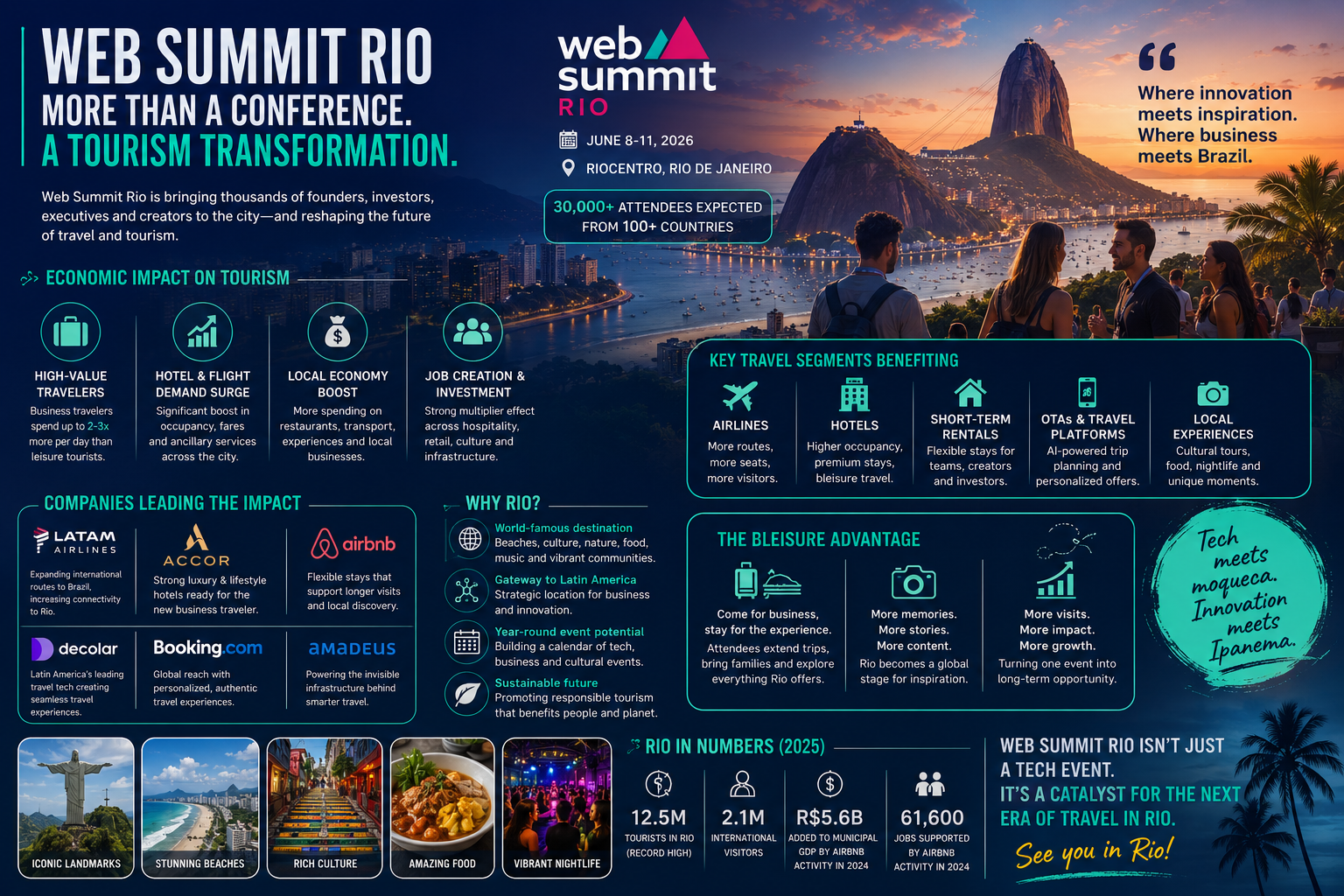
**Company research highlights behind the article: LATAM announced a Brazil international expansion from 370 to 440 direct international flights per week by early 2026, supporting the connectivity argument. Airbnb said a FGV study found Airbnb activity in Rio generated R$830.8 million in direct taxes, supported 61,600 jobs, and added R$5.6 billion to municipal GDP in 2024. Despegar, parent of Decolar in Brazil, completed its acquisition by Prosus in 2025 and describes itself as Latin America’s leading travel technology company. Amadeus reported that GenAI use in travel planning rose 64% year over year, while Booking.com’s 2025 travel research points to demand for authentic, sustainable and more personalized trips.
By Graham Cooke, Group Editor