Web Summit Rio: How Latin America’s Biggest Tech Stage Is Reshaping the Industry | News

Web Summit Rio has become more than another stop on the global conference circuit. It is now one of the clearest signals that Latin America is moving from the margins of the technology conversation to the center of it.
For years, the global tech industry has been dominated by a familiar map: Silicon Valley for venture capital, Europe for regulation and enterprise innovation, China for scale, and India for engineering depth. Latin America was often treated as an emerging market to enter, not an ecosystem to learn from. Web Summit Rio is helping change that perception.
By bringing global founders, investors, policymakers, enterprise leaders, creators and startups into Rio de Janeiro, the event gives the region something it has long needed: a high-visibility platform where local ambition meets international capital, talent and attention. The impact is not limited to Brazil. It reaches across the continent, influencing how startups are funded, how companies adopt artificial intelligence, how governments think about digital transformation, and how global firms view Latin America’s role in the next phase of technology.
Rio as a New Innovation Gateway
Rio de Janeiro has always been one of the world’s most recognizable cities, but Web Summit Rio is helping reposition it as a serious innovation gateway. The symbolism matters. A global technology event of this scale does not simply fill hotels and convention halls; it changes the story a city tells about itself.
For Rio, the message is clear: the city wants to be known not only for culture, tourism and creativity, but also for startups, digital infrastructure, investment and industry transformation. Hosting Web Summit through the end of the decade gives Rio a recurring opportunity to attract international companies, venture funds, accelerators and media attention.
That continuity is important. One-off events create excitement. Repeated events create ecosystems. When founders know they can return each year to meet investors, when enterprises know the region’s best startups will gather in one place, and when governments can align policy conversations around a major global platform, the conference becomes a catalyst rather than a spectacle.
The AI Moment Meets Latin American Reality
Artificial intelligence has become the dominant theme in global technology, but its impact is not uniform. In Latin America, AI is not just about frontier models or abstract productivity gains. It is about solving practical problems in finance, logistics, education, healthcare, agriculture, retail, energy and public services.
This is where Web Summit Rio has particular importance. It creates a stage for companies building AI for real-world constraints: uneven infrastructure, complex regulation, multilingual markets, informal economies, high financial exclusion and enormous demand for scalable services.
Latin American startups often operate in conditions that force discipline. They must build products that are affordable, mobile-first, resilient and directly tied to user value. As AI adoption accelerates, that experience becomes an advantage. The region can become a proving ground for applied AI: not just impressive demos, but tools that reduce fraud, improve customer service, expand credit access, optimize supply chains and support public-sector efficiency.
For the wider industry, this matters because the next wave of AI value will not come only from model development. It will come from deployment. Web Summit Rio highlights the companies and markets where AI must become useful, trusted and economically viable.
A Bridge Between Global Capital and Regional Founders
One of the biggest effects of Web Summit Rio is the compression of distance between Latin American founders and global investors. In emerging ecosystems, access is often the hidden barrier. Good startups exist, but they may lack warm introductions to international funds, enterprise buyers, strategic partners or global media.
A major conference changes that equation. It gives founders a place to pitch, network, validate their products, study competitors and understand investor expectations. It also gives investors a more efficient way to scan the region, meet local operators and identify category leaders before they become obvious.
This can influence the flow of capital. When investors repeatedly visit a market, they become more comfortable with its risks and more aware of its opportunities. They learn which sectors are growing, which founders are credible, which regulatory shifts matter and which local partners can help them navigate the environment.
For startups, this visibility can be transformative. A meeting at Web Summit Rio may lead to funding, but it may also lead to a pilot customer, a distribution partnership, a media opportunity or a talent connection. In ecosystems where every relationship compounds, the networking effect is one of the event’s most powerful contributions.
Enterprise Innovation Gets a Regional Lens
Web Summit Rio is not only a startup event. Its impact also extends to large companies trying to modernize. Banks, telecoms, retailers, energy companies, logistics firms and public-sector institutions across Latin America are under pressure to digitize faster. They need better data systems, stronger cybersecurity, AI adoption strategies, new payment infrastructure and more agile product development.
By placing enterprise leaders in the same environment as startups and global technology companies, the event encourages cross-pollination. Established firms can see what is coming next. Startups can understand what large customers actually need. Investors can identify where enterprise budgets are moving.
This matters because Latin America’s digital transformation will not be driven by startups alone. It will require partnerships between incumbents and challengers. Web Summit Rio provides the meeting ground where those partnerships can begin.
The Industry Impact: From Visibility to Ecosystem Power
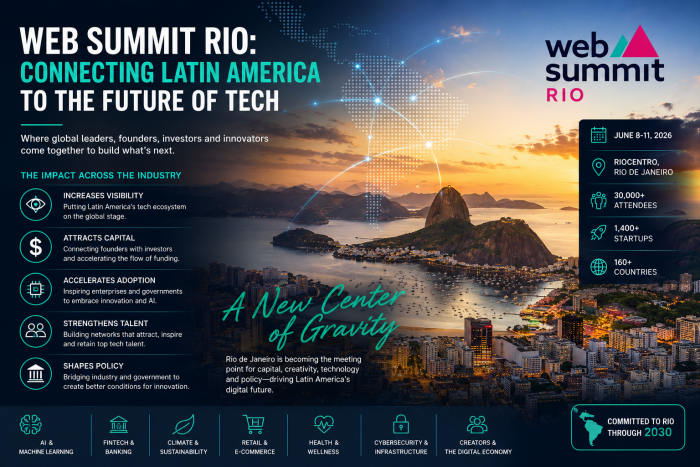
The broader impact of Web Summit Rio can be understood in five areas.
First, it increases visibility. Latin America’s technology sector has long produced strong companies, but global narratives often lag reality. A major international event helps correct that imbalance.
Second, it attracts capital. Investors follow density: dense networks, dense talent, dense opportunity. Web Summit Rio creates a recurring moment of density for the region.
Third, it accelerates adoption. When executives see competitors experimenting with AI, automation, fintech, cybersecurity and cloud infrastructure, they are more likely to act.
Fourth, it strengthens talent flows. Conferences help engineers, product leaders, designers, marketers and founders see themselves as part of a larger ecosystem. That sense of belonging matters in retaining talent and inspiring new companies.
Fifth, it shapes policy conversations. Technology growth depends on regulation, infrastructure, education, data governance and public-private coordination. A global event gives policymakers direct exposure to the people building and financing the future economy.
Why Latin America’s Moment Matters Globally
The significance of Web Summit Rio is not only regional. The global tech industry needs new centers of growth. Mature markets are crowded, expensive and increasingly regulated. Meanwhile, Latin America offers a large, young, mobile-first population, deep fintech adoption, strong creator economies, fast-growing startup communities and major opportunities in climate, energy, agriculture and financial inclusion.
Brazil, in particular, is too large to ignore. It has the scale of a continental market, a sophisticated financial system, a growing AI and software sector, and deep ties to both Western and emerging economies. Rio’s rise as a recurring tech gathering point gives Brazil a stronger role in shaping global industry conversations.
For global companies, the message is straightforward: Latin America is not just a market for expansion. It is a source of innovation, talent and business models that can travel elsewhere.
Challenges Still Remain
The momentum is real, but it should not be romanticized. Conferences can open doors, but they do not solve structural problems on their own. Latin America still faces challenges around funding depth, bureaucracy, infrastructure inequality, currency volatility, education gaps and uneven digital access.
The true test of Web Summit Rio’s impact will be what happens after the stages go dark. Do startups secure lasting partnerships? Do investors continue writing checks? Do enterprises move from inspiration to implementation? Do governments translate visibility into better innovation policy? Do local communities benefit from the economic activity and digital opportunities created around the event?
If the answer is yes, Web Summit Rio will become far more than a conference. It will become a mechanism for ecosystem building.
Conclusion: A New Center of Gravity
Web Summit Rio arrives at a critical moment for the technology industry. AI is changing how companies operate. Venture capital is becoming more selective. Governments are rethinking digital sovereignty. Enterprises are racing to modernize. Startups are searching for markets where technology can produce immediate, measurable value.
Latin America sits at the intersection of all these forces.
That is why Web Summit Rio matters. It gives the region a global stage, but more importantly, it gives the global industry a reason to pay closer attention to the region. The event is helping turn Rio into a meeting point for capital, creativity, technology and policy. It is also helping redefine Latin America’s role in the digital economy.
The future of technology will not be built in one city, one country or one ecosystem. It will be built through networks. Web Summit Rio is becoming one of the most important nodes in that network — and its impact on the industry is only beginning.
By Graham Cooke, Group Editor