European travel programmes more mature than global average; UK signals stronger strategic capacity | News

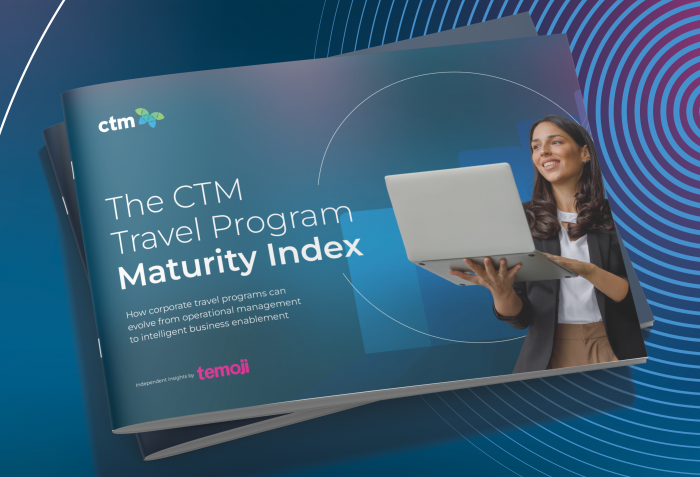
The CTM Travel Programme Maturity Index, launching exclusively at Business Travel Show Europe next Wednesday, shows European travel programmes are more mature than their global counterparts, and the UK – specifically – signals stronger strategic capacity.
Drawing from survey responses from 274 travel managers worldwide plus a series of qualitative interviews, the Index is a practical framework for understanding the current status of corporate travel programmes. It also highlights which capabilities differentiate higher-maturity programmes and how organisations can progress from traditional managed travel toward intelligent travel management.
European respondents averaged 45.6/100, almost two points above the total sample benchmark of 43.7/100.
UK respondents are more likely to spend time on strategy, optimisation and planning: 38.9% versus 22.7%.
The report, with independent insights from Temoji Consulting, suggests the industry’s next maturity challenge is not stronger control, but stronger intelligence: the ability to connect systems, translate data into action, adapt to change, and align travel with broader business outcomes.
For organisations, higher maturity means travel programmes are better equipped to reduce operational burden, improve traveller confidence, strengthen stakeholder visibility and support smarter business decisions.
“The CTM Travel Programme Maturity Index shows corporate travel programmes are evolving from operational management toward strategic business enablement,” said Eleanor Noonan, Global COO and UK interim CEO.
“The industry has built strong foundations around policy, supplier strategy, compliance and cost control. The next opportunity is to build the intelligent capabilities that allow travel programmes to create greater value for the business and the traveller. The future will belong to organisations with the most sophisticated technology and those that can connect data, align stakeholders, reduce operational burden and continuously adapt as business needs change.”
Traveller experience as important as cost control
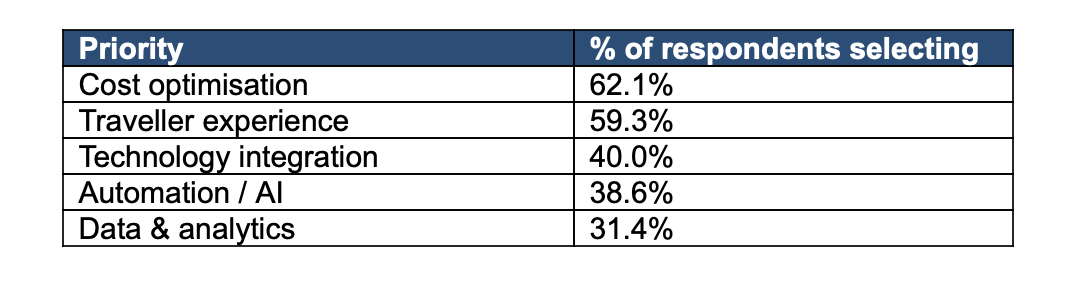
The CTM Travel Programme Maturity Index also shows success is no longer defined by cost alone. While cost optimisation (62.1%) remains the top priority, traveller experience (59.3%) is almost as important, suggesting travel leaders are increasingly measured not only by savings and compliance, but by their ability to create programmes that work for the organisation and the traveller: the definition of maturity.
Additional key findings included:
The biggest barriers are organisational. Technology limitations, budget constraints, resource shortages and organisational silos are the primary obstacles preventing programmes from advancing.
Connected data and intelligence differentiate leading programmes. Higher-performing programmes are more likely to integrate travel data across the business, enabling better decisions, stronger stakeholder value and greater strategic impact.
AI is an accelerator, not the destination. While AI adoption is still in its early stages, the future belongs to intelligent travel programmes that use data, technology and automation to improve decisions, traveller outcomes and business performance.
Common behaviours of higher-maturity programmes
While mature programmes may pursue different objectives, the strongest consistently exhibit these common behaviours:
Shift from cost control alone toward business outcome optimisation.
Use travel data to inform decisions beyond the travel team.
Integrate travel data with finance, HR, risk and operational systems.
Spend more leadership time on strategy and optimisation than issue resolution.
Treat suppliers as strategic partners rather than transactional vendors.
Use technology and automation to improve consistency, visibility and traveller support.
Connect risk, sustainability and compliance into broader organisational reporting.
Corporate travel buyers can access the report before the wider release, along with a simple assessment to see how their travel programme rates on the Maturity Index Scale, exclusively and free of charge from the CTM stand at Business Travel Show Europe (K21) on 24 and 25 June.
The report will be available on the CTM website from early July: https://travelctm.com
The five stages of maturity
1. Reactive
Travel is fragmented and operationally inconsistent. Visibility is limited, processes vary and the priority is to create basic control and reduce unmanaged activity.
2. Controlled
Core structures are in place, including policies, suppliers, approvals and reporting. The priority is consistency, compliance and operational control.
3. Optimised
The programme actively improves performance. Data informs decisions, supplier performance is reviewed, traveller adoption improves and processes become more standardised.
4. Strategic
Travel is aligned to broader business priorities. Reporting extends beyond spend and compliance to include traveller outcomes, supplier value, productivity and risk.
5. Intelligent
The programme operates through connected systems, integrated data, automation and predictive insights. The priority is continuous optimisation through intelligence and integration.