
IATA AGM 2026: LATAM’s Rise Reflects a Region Coming of Age | News

When the airline industry’s leaders last gathered in Rio de Janeiro for an IATA Annual General Meeting in 1999, Latin American aviation occupied a very different place in the global system.
At the time, the region accounted for just 4% of global air traffic and carried around 68 million passengers annually. Its airlines were largely domestic champions, operating fragmented networks with limited international reach. LAN and TAM, the two carriers that would eventually merge to create LATAM Airlines Group, operated separately, carrying a combined 12 million passengers with fleets totalling just over 100 aircraft.
Twenty-seven years later, IATA has returned to Rio, but the conversation has changed dramatically. The host airline is no longer a national carrier focused primarily on its home market. LATAM has become one of the world’s largest airline groups, carrying 87.4 million passengers in 2025, operating 375 aircraft and connecting 161 destinations across 27 countries. More importantly, it has emerged as a symbol of a broader transformation taking place across Latin American aviation.
The significance of LATAM hosting the AGM extends beyond corporate achievement. It reflects a region that is increasingly moving from the periphery of global aviation towards the mainstream.
A region that grew faster than many expected
One of the most revealing statistics presented by LATAM during the AGM was not about the airline itself, but about the region it serves.
Since IATA last met in Rio in 1999, passenger traffic carried by Latin American airlines has grown by 557%, reaching more than 447 million passengers annually. The region’s share of global passenger traffic has increased to 5.4%, while its share of global Revenue Passenger Kilometres has reached 7%. Regional load factors now stand at 83%, reflecting a market that has become significantly more efficient and commercially mature.
Those numbers tell an important story. Latin America is often discussed through the lens of political volatility, economic cycles and infrastructure challenges. Yet over the past quarter century it has quietly become one of aviation’s more significant growth markets.
The region remains smaller than North America, Europe or Asia-Pacific, but it is considerably more connected than it was a generation ago. New hubs have emerged, international networks have expanded and airlines have become increasingly sophisticated in their ability to compete on a global stage.
Hosting the AGM in Rio is therefore not simply recognition of Brazil’s importance. It is recognition that Latin America itself has become impossible to ignore.
LATAM’s evolution mirrors the region’s
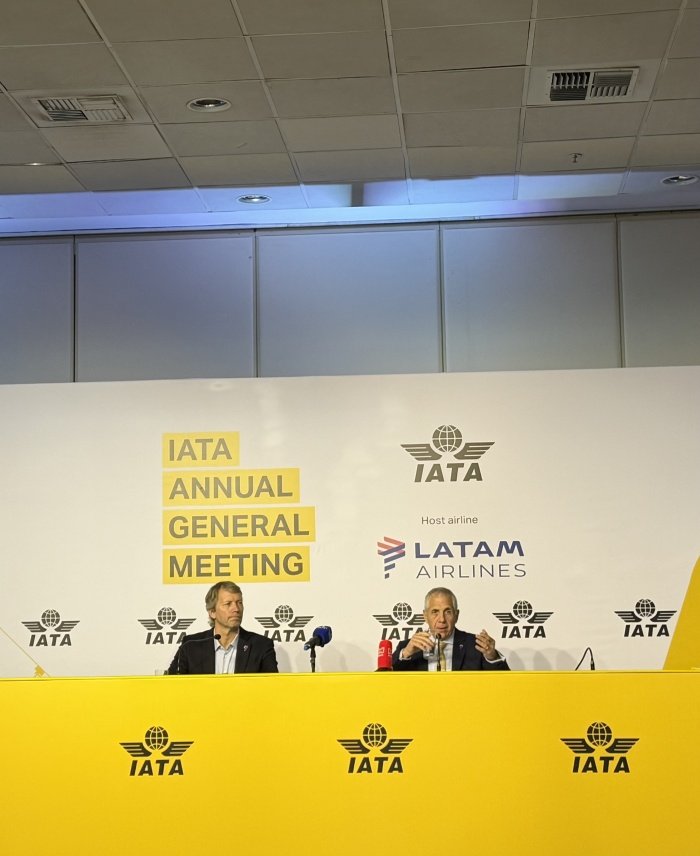
 Jerome Cadiier
The story of LATAM closely follows the evolution of South American aviation itself.
The merger between LAN and TAM created something the region had historically lacked: an airline group with the scale to think continentally rather than nationally. What emerged was not simply a larger airline, but a platform capable of connecting South America internally while also linking it more effectively with the rest of the world.
Today, LATAM describes itself as the only airline group in the region connecting South America directly with four continents: North America, Europe, Africa and Oceania. Its network spans more than 1,600 daily flights and serves as a critical piece of infrastructure for trade, tourism and investment flows throughout the continent.
That distinction matters because connectivity remains one of Latin America’s enduring challenges. The geography is vast, populations are dispersed and economic activity is often concentrated in relatively few metropolitan centres. Strong airline networks play an outsized role in knitting together both national economies and the wider region.
In many respects, LATAM has become less an airline and more a connector of economic ecosystems.
Brazil becomes the engine
The AGM also highlighted another important shift underway in regional aviation: the growing importance of Brazil.
While South America has traditionally lacked a single dominant aviation market comparable to the United States or China, Brazil is increasingly filling that role. LATAM now describes Brazil as the group’s primary growth engine and the platform from which it projects connectivity to the rest of the world.
The numbers support that argument.
LATAM carried 38.8 million domestic passengers in Brazil during 2025, while domestic market share increased from 34% in 2019 to 40% in 2025. Corporate market share grew even faster, rising from 28% to 42% over the same period. The airline now operates 176 aircraft in Brazil, employs more than 23,000 people and serves 62 domestic and 27 international destinations from the country.
For aviation executives gathered in Rio, Brazil increasingly resembles the market that could drive the next phase of Latin American aviation expansion. Its growing middle class, expanding domestic network and strategic position between North America, Europe and the South Atlantic create advantages few regional competitors can match.
A different kind of global airline
One of the more interesting aspects of LATAM’s evolution is how diversified its business has become.
The group’s cargo division carried more than one million tonnes in 2025, generating approximately US$1.7 billion in revenue and accounting for more than 11% of group revenues. Its cargo operation has become the leading player in South America and was named Cargo Airline of the Year by Air Cargo News, the first South American carrier to receive the recognition in two decades.
Its loyalty business is equally significant. LATAM Pass now has more than 54 million members, with a target of reaching 100 million by 2030. According to the airline, an award ticket is redeemed every three seconds.
These developments mirror a wider shift occurring across global aviation. Airlines increasingly generate value not only from transporting passengers but through ecosystems that combine loyalty, financial services, cargo, technology and partnerships. In that respect, LATAM increasingly resembles its peers in North America, Europe and the Gulf.
The challenge of sustaining momentum
The picture presented in Rio was overwhelmingly positive, but it would be premature to suggest Latin America has solved all of its aviation challenges.
The region still accounts for only 5.4% of global passenger traffic despite representing roughly 8% of the world’s population. Infrastructure investment remains uneven. Political and economic volatility continue to affect airline planning. Cross-border connectivity within Latin America remains weaker than many industry leaders would like.
At the same time, sustainability will require significant investment. LATAM has committed to net-zero emissions by 2050, plans to invest US$100 million in sustainability initiatives by 2030 and is targeting a fleet that is more than 50% next-generation aircraft by the end of the decade.
Those ambitions reflect broader industry realities. Growth is no longer enough. Airlines must grow while modernising fleets, improving customer experience, digitising operations and reducing emissions.
More than a host airline
 Roberto Alvo
There is a temptation to view host airlines at industry events as little more than sponsors and organisers.
That would miss the larger significance of LATAM’s role in Rio.
The airline’s trajectory tells a story about South America itself. Twenty-seven years ago, Latin America was a relatively small participant in global aviation, characterised by fragmented markets and limited long-haul connectivity. Today it supports world-class airline groups, increasingly sophisticated hubs and hundreds of millions of annual passengers.
The region still has substantial room for growth. Passenger penetration remains below many developed markets, infrastructure gaps persist and economic integration remains incomplete. Yet the direction of travel is unmistakable.
If the last quarter century was about proving Latin America could build globally competitive airlines, the next may be about demonstrating that it can become one of the aviation industry’s most important growth regions.
For LATAM, hosting the AGM is a recognition of how far the company has travelled since the days of LAN and TAM. For Latin America, it serves as a reminder that aviation is no longer simply connecting the region to the world.
Increasingly, it is helping the region claim a larger place within it.