Why Yield Optimization Is the Only Travel AI Story That Matters Right Now

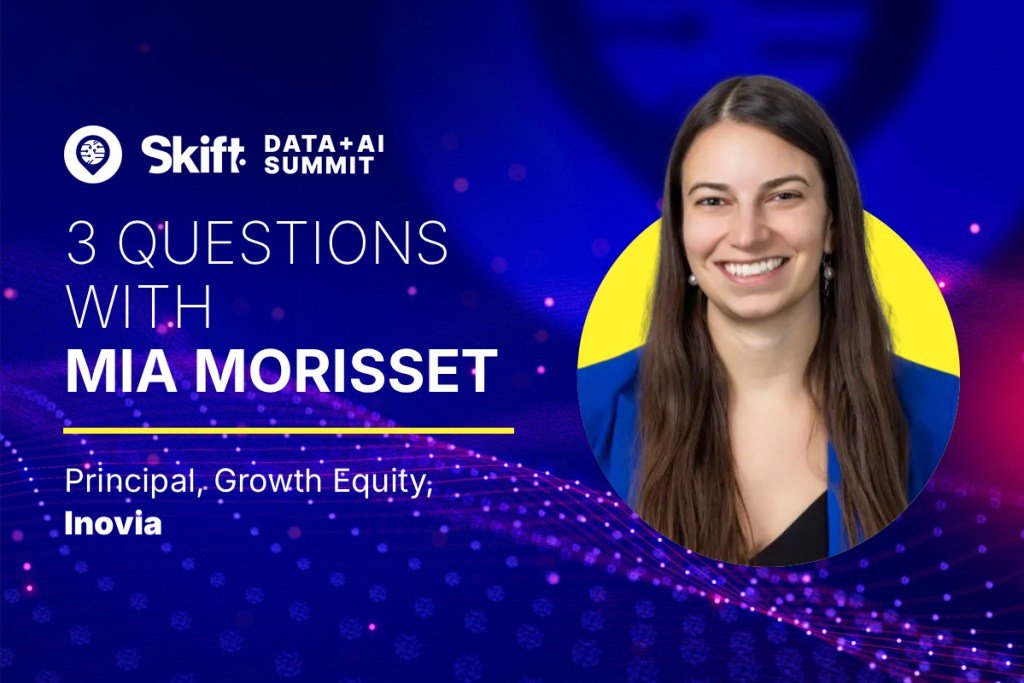
As a venture investor and operator who has tracked the sector closely through its post-COVID reshaping, Mia Morisset has developed a framework that cuts past the demo layer: does the AI become the core product, or does it stay bolted on as a feature?
Travel has no shortage of AI announcements. It has a shortage of AI businesses with structural defensibility. Morisset is one of the clearer voices on where that line sits, and at Skift Data + AI Summit 2026 in New York City on June 3, she will draw it in detail.
The Revenue Layer
Skift: What types of AI applications in travel are you most confident will scale into durable businesses?
Morisset: Yield and ancillary optimization is where I’d put my chips. Companies like Hopper, TravelX, and Fairlyne are finally capturing revenue that was always there but too complex to unlock manually —personalized upsell at booking, post-booking seat buyback, transferable ticket markets, loyalty monetization. In today’s macro environment, a 1% uplift in gross profit isn’t a nice-to-have, it’s a board conversation. And the defensibility is structural: the model gets smarter with every transaction.
The other area I’m excited about is corporate travel. Business travel is back, but the way companies travel has fundamentally changed — bleisure, team offsites, hybrid work patterns — and yet most of it is still unmanaged. Naboo and Boompop are going after this in interesting ways. What makes the opportunity compelling is that most incumbents here were built as service businesses — lots of humans, lots of manual coordination. AI doesn’t just improve that model, it has the potential to completely reinvent it.
What Actually Scales
Skift: Where are you currently seeing the clearest evidence of AI creating defensible ROI in travel companies?
Morisset: The first thing I look for is whether AI has become the core product or is still bolted on as a feature. Guesty is a good example of the transition done right — trained on 500K+ listings, their AI suite now touches pricing, guest messaging, fraud detection, and listings. Every workflow gets smarter over time. That’s a system of intelligence, not just a system of record.
Then I look at unit economics. Super.com is the proof point I keep coming back to: $200M+ in annualized revenue with just over 200 employees. Their latest product went from $0 to $100M ARR in two years — not because of a hot market, but because they rebuilt their operations around AI. Support, pricing, personalization — all transformed. That ratio of revenue to headcount would have been unthinkable a few years ago.
The third signal is distribution moats. Hopper‘s Technology Solutions nails this — by embedding price freeze and cancel-for-any-reason directly into airline and OTA checkout flows, they earn revenue without ever acquiring the end traveler. Every new partner generates more data, which sharpens the risk pricing, which attracts more partners. TripAdvisor is already seeing 15% of hotel bookers purchase an HTS product across 190 countries. That’s a flywheel, not a feature.
The Capital Trap
Skift: Where do you see capital being misallocated in travel AI today?
Morisset: A lot of it is going into AI trip planners that are essentially demos. Great UX, impressive engagement — but no real answer to how they monetize at scale. Engagement without a wedge is challenging to scale.
There’s also a lot of capital chasing generic chatbot platforms with a travel-themed landing page. They get early traction because any automation helps in an industry that’s still largely manual — but they don’t have the domain-specific data or workflow depth to actually move the needle for operators. The travel veneer wears off fast.
And then there’s the subtler one: companies that mistook a post-COVID tailwind for product-market fit. A lot of AI-adjacent travel businesses grew strongly as travel snapped back, but growth in a rising market hides a lot. The real question is what GDR/NRR looks like when things normalize. Companies that scaled on new logos without building retention are going to have a harder time than their growth curves suggest.
Hear Mia Morisset at Skift Data + AI Summit
Travel AI has entered a more disciplined chapter. The winners increasingly look like companies with operational depth, proprietary data loops, embedded distribution, and measurable margin impact.
Mia Morisset’s session at the Skift Data + AI Summit 2026 in New York City on 3 June will speak directly to the executives, founders, investors, and operators trying to separate durable advantage from temporary momentum.
With attendance nearing capacity, only a limited number of seats remain.
↔️ Plans not final? Reassign tickets later.
🧾 Invoice or wire needed? events@skift.com
FOR TEAMS ATTENDING TOGETHER
Group Tickets
FOR ONE ATTENDEE
Solo Ticket
For single-ticket purchases only.
$995