Award Flight Fuel Surcharges: Increases Abound

If you’ve booked an award flight in the last month, you’ve probably noticed something unpleasant happening to the taxes and fees line on your itinerary. It’s gotten bigger. A lot bigger.
Since the US-Israel war with Iran erupted in late February, jet fuel prices have roughly doubled, surging from around $96 to $197 USD per barrel in about five weeks. The closure of the Strait of Hormuz, through which nearly 20% of the world’s oil supply flows, sent shockwaves through energy markets that airlines simply cannot absorb. And now, those costs are landing squarely on the shoulders of anyone trying to redeem their hard-earned miles and points.
Let’s look at what comes next, especially now there’s a potential light at the end of the tunnel with a potential ceasefire announced on April 7, 2026.
Airlines & Frequent Flyer Programs With Increased Fuel Surcharges So Far
Air Canada Vacations
Air Canada Vacations implemented a $50 CAD per-passenger surcharge on all bookings with a flight component starting April 6. This applies to sun destination packages and is reflected in the selling taxes and surcharges at the time of booking. Existing bookings aren’t affected.
Porter Airlines
Porter was one of the first Canadian carriers to make a move, adding a flat $40 CAD “Peak Surcharge” per direction on all VIPorter reward bookings effective March 23. Previously, VIPorter redemptions were completely exempt from this kind of fee.
Porter has said the surcharge is temporary and will be removed when fuel prices stabilize, though anyone who’s followed this industry knows how “temporary” airline fees tend to be. For a short domestic flight, an extra $80 roundtrip on a points booking is a meaningful hit to the value proposition.
WestJet
WestJet announced a $60 CAD fuel surcharge on all companion voucher bookings effective April 8. The surcharge applies to vouchers earned through both the WestJet RBC World Elite Mastercard and WestJet Rewards Elite status, and gets added to the “Other ATC” line on your booking. This has been a sneaky way WestJet passes fuel costs onto consumers, and sadly, it looks like this crisis isn’t going to waste.
Sunwing and Vacances WestJet (Quebec only) are also adding fuel surcharges to all bookings starting April 14.
Air France-KLM Flying Blue
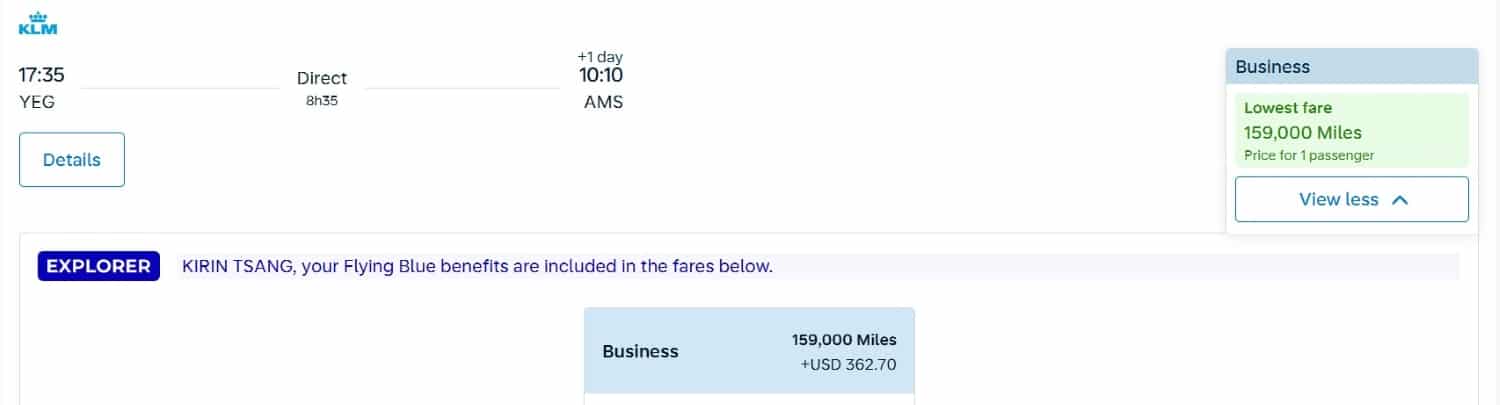
Without any formal announcement, Air France-KLM raised Flying Blue award surcharges by roughly $60 USD in economy and $100 USD in business class per direction for flights on Air France and KLM aircraft. That means a business class round-trip itinerary from Edmonton (YEG) to Amsterdam (AMS) might run north of $1,000 CAD in taxes and fees alone, depending on the exchange rate.
Some reports indicate you can book Air France metal through Japan Airlines Mileage Bank, but this is a Bilt Rewards and Capital One Miles transfer partner, so only a limited number of Canadians in the US credit card game would have any luck.
ANA
ANA Mileage Club updated its fuel surcharge schedule effective April 1, with flights originating in Canada costing $229 CAD per direction, and around $165 USD from the US. But here’s the thing: like JAL, they intend on offsetting prices on a rolling two-month basis. So if prices really rise now, those costs will be passed along in June and July.
In other words, the real pain on Japanese carrier surcharges hasn’t even arrived yet. Both airlines are expected to roughly double surcharges for June issuances. If you’re looking to book ANA business class with points, doing it through Aeroplan remains the surcharge-free play.
Cathay Pacific
Cathay Pacific has been perhaps the most aggressive mover. The airline doubled fuel surcharges on March 18, then raised them by another 34% on April 1. A round-trip long-haul award ticket through Asia Miles now carries roughly $400 USD in fuel surcharges alone.
Cathay has shifted to biweekly surcharge reviews instead of monthly, which tells you just how aggressively they intend to pass the volatility onto consumers. There’s one silver lining: reports indicate you can book Cathay metal through AAdvantage or Atmos Rewards without getting hit by some carrier-imposed surcharges, at least for now (assuming, of course, you can find availability).
Others
The list goes on. Hong Kong Airlines raised surcharges by about 35% on some routes starting March 12. SAS introduced “temporary fuel-related price adjustments.” Qantas is raising international fares by roughly 5%. British Airways, Iberia, and Finnair have all raised fees on partner awards.
Air India introduced phased surcharges reaching up to $200 USD per direction on long-haul routes. Thai Airways, Air New Zealand, and Virgin Australia have all announced fare increases. The trend is global, and it’s affecting both cash and award tickets. Budget airlines Flair and Air Transat have already folded the charges into their fares.
What Can We Expect Next With Fuel Surcharges?
Here’s the uncomfortable truth about fuel surcharges: historically, they don’t come back down, even when fuel prices do. Airlines introduced them decades ago as a “temporary” response to oil price spikes, and most never bothered removing them when oil dropped back. In researching this article, the last time I saw an airline openly announce this was 2008, for an amount of 3-5€. Lol, lmao, even.
I do have some limited good news: Aeroplan redemptions remain exempt from fuel surcharges. Air Canada has raised paid fares and updated its Rule 115 surcharge schedule as of April 1, 2026, causing the cost of cash fares to rise. The fact that this hasn’t happened thus far has been one of Aeroplan’s most valuable differentiators since the program relaunched in 2020.
If oil prices stay elevated, worse than my blood pressure watching the Edmonton Oilers attempt to bail out Tristan Jarry, the push to reintroduce surcharges on award tickets will mount. Therefore, peace is preferable both for everyone’s livelihood and safety, as well as our admittedly first-world miles and points problems.
Programs that don’t levy fuel surcharges on awards are looking more attractive than ever: Aeroplan, United MileagePlus, AAdvantage, Avianca LifeMiles, and KrisFlyer (on Singapore aircraft) are probably a good choice for your next trip if you can access them in sufficient quantities.
A Glimmer of Hope In The Near Future?
Up until the ceasefire was inked, it was probably ideal to book travel now to lock in fuel surcharges. Nobody at Frugal Flyer can tell the future, but the possibility of a permanent end to hostilities may mean you consider waiting. Though let’s be real: if you have somewhere you need to be, such as visiting or spending time with a loved one or a vital work opportunity, don’t hesitate. Don’t sacrifice once-in-a-lifetime moments like a honeymoon due to fuel surcharges!

Geopolitics is beyond the scope of Frugal Flyer, but we certainly pray for safety, security, and well-being for all our readers and people around the world. We do love miles and points, but we also acknowledge that their redemption isn’t the sole important objective of this life.
We also mustn’t forget that, bad as the surcharges are, many Canadian carriers are probably operating at or near a loss, given fuel costs. $50 per passenger on Air Canada Vacations flights that may go as far as Mexico or the Caribbean probably won’t cover the cost of fuel, whereas the Asian carriers have shown us how aggressive the hikes might be just to break even.
Conclusion
Surcharges suck, and let’s not pretend they don’t. Keep your eye on Aeroplan’s continued exemption, book through surcharge-free programs where you can, and if you’re sitting on a redemption through a program that does charge them, consider locking it in now.
Until next time, may your surcharges be low and your ceasefires be permanent.