Trip.com Group on Why Going Global Means Becoming the Best Local Player in Every Market

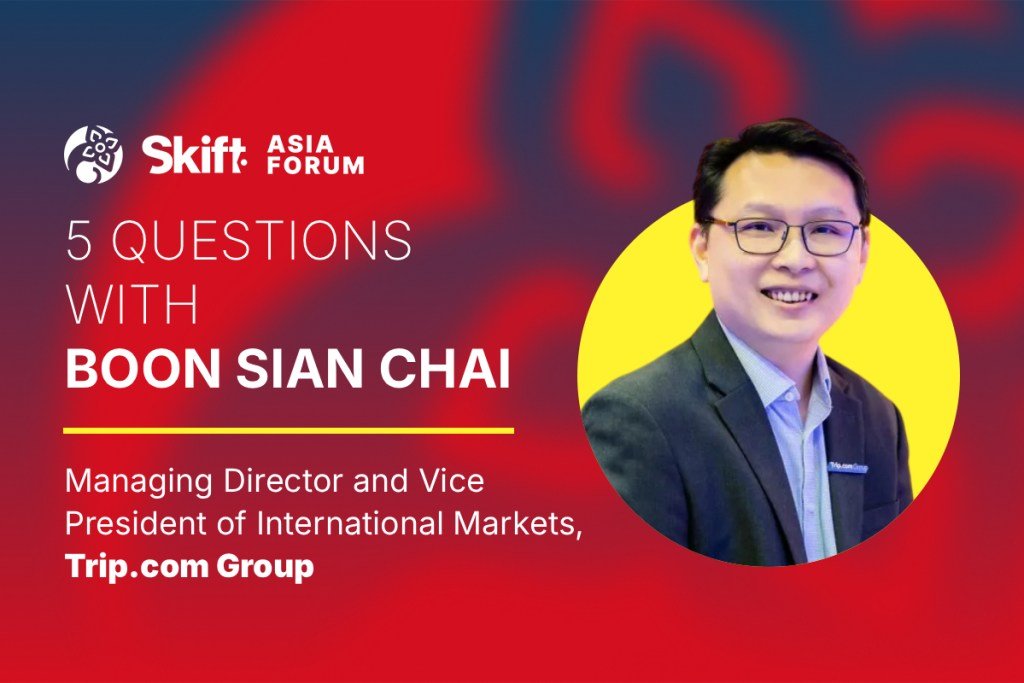
As Managing Director and Vice President of International Markets at Trip.com Group, Chai, has scaled a platform built in Asia across more than 200 countries, each with radically different payment rails, traveller psychology, and cultural expectations.
He talks about “Skillvenirs” — travellers who now choose destinations based on the skill they want to return with: a tea ceremony in Kyoto, a cooking class in Bologna, a yoga practice in Bali. Chai sees travellers shifting from sightseeing to soul-seeking, from passive observers to active participants.
At Skift Asia Forum 2026, happening this week, Chai joins a session asking one of the most commercially loaded questions in travel right now: Can Asia take its travel playbook global? Given what Trip.com has already shipped, he arrives with answers, not hypotheses.
1. What role do events, lifestyle, or intentional experiences play in engaging customers?
“Events have become the anchors of the global travel calendar. A single concert, sporting championship, or lifestyle festival can now dictate the travel patterns of millions. According to our Momentum 2025 report, 63% of travellers have planned a trip specifically around a live event.
For major K-POP concerts in Hong Kong in 2026, such as those by BLACKPINK and SEVENTEEN, premium tickets sold out within ten seconds, and the entire allocation were snapped up within an hour on Trip.com. Millions of fans visited our website, with peak platform traffic exceeding 300,000 users per second.
As the exclusive overseas ticketing partner for AnimeJapan 2026 in Tokyo, we saw international ticket sales surge 697% year on year, with travellers from 82 countries and regions.
We are no longer selling a hotel room; we are selling access to a lifestyle moment. By bundling events with seamless logistics — flights, accommodation, and local transport — we turn a transaction into a holistic experience.”
2. Where are you seeing the biggest shifts in distribution, platform use, or creator influence?
“The most significant shift in distribution in Asia is the consolidation of the traveller journey within integrated ecosystems, where a single gateway manages inspiration, payment, and in‑destination support.
The creator economy has matured: influence is no longer about brand awareness and engagement but measurable conversion. Our ‘Super World Trip’ livestream series exemplifies this, converting engagement into over 20,000 hotel room nights in a single campaign — demonstrating that creators are now integral to the distribution funnel.
Simultaneously, platform use is moving towards AI‑supported interfaces. Travellers are moving from traditional filters to natural language queries, making a seamless conversational experience as critical as inventory. Success in APAC now hinges on distributing the right product, at the right price, through either a creator’s voice or an AI‑powered recommendation.”
3. What is one lesson you have learned about scaling across multiple markets?
“The most important lesson is that going global demands hyperlocalisation. There’s no such thing as a ‘standard traveller.’
A strategy that works in Kuala Lumpur — where social media trends and K-pop concerts drive demand — can’t simply be applied to Tokyo, where travellers prioritise seasonal nature experiences and traditional luxury cruises. Middle Eastern travellers often focus on large family logistics and privacy, while European travellers are increasingly drawn to food-led discovery, concerts, and international sporting events.
Successful scaling means building a flexible platform that can be localised at the edge: from user interface and marketing tone to the products prioritised in search results. Equally important is local execution expertise — solving local pain points such as visa complexities or language barriers using a global technology stack. This creates a competitive advantage that neither purely local nor purely global players can replicate.
The principle is simple: to be a global leader, you must become the best local player in every market you enter.“
4. What are travelers expecting now that is different from a few years ago?
“Travellers today expect two shifts compared with a few years ago: actionable sustainability and real‑time intelligent support.
Sustainability is no longer just a marketing tagline. It has shifted from a ‘nice-to-have’ option to a default expectation. Today, travellers treat sustainability as a climate-adaptive practice that they proactively consider… search for cooler destinations, choose to book electric vehicles, and opt for lower-carbon hotels.
At the same time, the ‘book and forget’ model is obsolete. Travellers expect a digital concierge that stays with them throughout the journey: real‑time AI assistance for translation, disruption management, and last‑minute bookings. The platform must act as a safety net in their pocket, moving focus from the point of sale to the point of experience.
Meeting these expectations requires deep investment in AI and in‑trip infrastructure.”
5. Which trends do you think will define the next phase of travel across the region?
“Three trends will define the next phase:
Autonomous AI agents — The shift from search tools to journey partners. An agent will know your calendar, preferences, and constraints, then proactively book, re‑route, and rebook around disruptions. The enablers are AI-ready (internal systems structured for machine consumption) and AI-friendly (open to external agents) infrastructure.
Travel to heal — Wellness trips are evolving beyond spas. Travellers now seek combinations of exertion and recovery. Searches for ‘golf & spa resorts’ grew +300% year-over-year, and ‘ski & spa’ packages rose +250%. This is ‘Wellness 2.0’ in action: mental longevity, bio-hacking retreats, and digital detoxes, but anchored in active, measurable experiences.
The low‑tech paradox — As AI handles complexity, travellers will pay a premium for authentic, unmediated experiences. The most advanced platforms will differentiate by curating offline connection — not despite technology, but because of it.”
The Broader Conversation Playing Out at Skift Asia Forum
Chai introduces a prediction that stands out: astro-tourism and space-adjacent travel moving from novelty to a fast-growing niche faster than expected.
Not commercial moon flights, but a surge in travellers adopting a space-faring mindset, turning extreme geography into the new bucket list. Search interest for space travel experiences has already surged over 600%, according to Trip.com data.
Skift Asia Forum 2026 convenes the operators, investors, and product leaders shaping how travel scales across the world’s fastest-moving region.
Chai’s session sits within that broader conversation, connecting what Asian platforms have already built with how that model travels beyond the region.