Why Booking.com Is Betting on the AI Travelers Will Never See

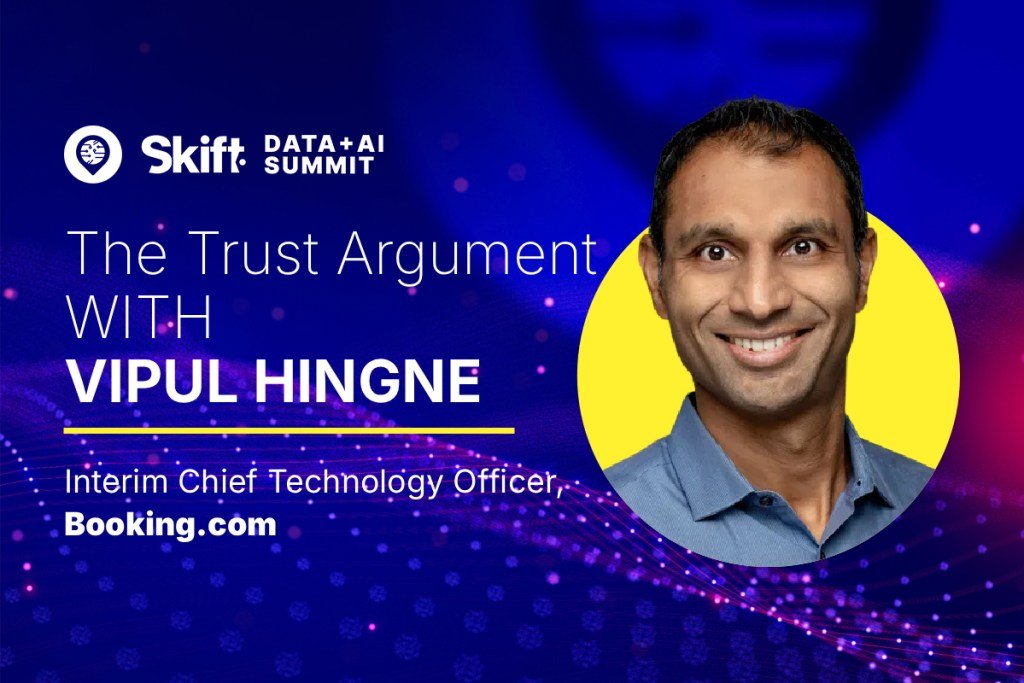
The race to build the best travel AI model has had two years to play out. The winners haven’t been determined by which model is most sophisticated. Vipul Hingne, Booking.com’s Interim Chief Technology Officer, is bringing a different competitive frame to Skift Data + AI Summit 2026.
The Competitive Variable Is Trust
Vipul’s argument is that the conversation has been calibrated wrong. AI capability is commoditizing fast. Models that were a competitive advantage 18 months ago are table stakes now. What remains scarce — and what actually determines whether a traveler completes the booking, pays through the platform, or hands off a decision to an agent — is trust.
“Success will not be determined by who has the best model or most radical innovations, but by who has the most trusted product.”
— Vipul Hingne, Booking.com
The stakes make this argument concrete. Travel transactions carry weight that most e-commerce purchases don’t, financially and emotionally. The asymmetry compounds in the use cases Vipul flags directly: agentic AI and payments. When the technology is choosing flights, locking in non-refundable bookings, or moving money on the traveler’s behalf, trust is not a soft attribute. It is the operational gate that determines whether the use case ships at all.
Companies competing on model quality are optimizing for a variable that’s converging. Those competing on trust are building something harder to replicate.
Two Frameworks He’s Bringing
1. The Invisible AI Standard. Most travel AI investment gets justified by what customers will see — branded assistants, visible chatbots, AI features that can be marketed as features. Vipul argues the inverse. The most valuable AI in travel is the work travelers never consciously notice: surfacing the right options, removing friction, personalizing recommendations, resolving support issues before they escalate. AI that announces itself competes for attention. AI that quietly improves the experience compounds trust over time.
Visible AI
What customers experience as AI
1
Branded AI assistants
Customer-facing chatbots positioned as the company’s AI product.
2
Agentic booking flows
AI that books on the traveler’s behalf, marketed as the feature.
3
AI-labeled search
Search results explicitly framed as “AI-powered.”
4
Conversational trip planning
Chat interfaces that ask the traveler what they want.
5
Generated itineraries
AI-produced trip plans presented as deliverables.
6
AI concierge upsells
AI surfacing add-ons, upgrades, ancillaries as recommendations.
Invisible AI
What works without announcing itself
1
Ranking and relevance
What gets surfaced first in search, tuned per traveler.
2
Friction removal in booking
Pre-filled fields, smart defaults, payment flow optimization.
3
Fraud and risk filtering
Detection running silently behind every transaction.
4
Customer support triage
Issue routing, priority scoring, agent assistance before the human shows up.
5
Pricing and availability prediction
Inventory and rate decisions made without traveler input.
6
Post-booking personalization
Property recommendations, timing nudges, content adjustments through the trip.
2. The Workforce Test. Vipul’s internal AI deployment is enterprise-wide, not engineering-tooling. AI is embedded across HR, Finance, collaboration, training — the systems non-technical staff use every day. The argument is that AI productivity is a workforce question before it is a technical one, and companies treating AI as something engineers build for the rest of the company to use are getting a fraction of the upside.
The Question He’ll Be Pressed On
Vipul‘s trust argument and the invisible AI standard both point at his session title directly. Trust compounds only when AI is running reliably across every interaction, and invisible AI isn’t a design choice — it’s a description of AI that has crossed from project to system. Most operators at the summit will say they’re operating AI. What they will mean is that they have shipped AI features, run pilots in production, integrated models into existing workflows. That’s deployment. Operating AI, in Vipul’s frame, means the system would visibly break if AI were removed, not lose a feature, break.
How much of what currently passes for AI strategy across travel is deployment dressed as operation?
The Session
Vipul joins Seth Borko, Skift’s Head of Research, for a session on what it takes to move AI from project to the system the business actually runs on.
Skift Data + AI Summit 2026 is two days away.
↔️ Plans not final? Reassign tickets later.
🧾 Invoice or wire needed? events@skift.com
FOR TEAMS ATTENDING TOGETHER
Group Tickets
FOR ONE ATTENDEE
Solo Ticket
For single-ticket purchases only.
$995